Seven Psychological Sins of SimCity Social

I have recently been hearing a lot about SimCity Social, the “Farmville with a candy coating of SimCity” game from Bigfish and EA. Mostly I’ve heard about how the game pulls all kinds of tricks to get players to spam each other, trade items, recruit new players, and spend real money. All of these things are par for the social game course, but apparently we have a more egregious than usual offender here. So I decided to investigate what psychological tricks SimCity Social pulls by forking over all kinds of pervasive permissions to my Facebook account and trying it out.

Wow. There’s so much going on here that within a few seconds I blacked out and woke up some time later in a puddle. I don’t know how this happened.

What I do know, though, is that SimCity Social wears many of its machinations on its custom tailored sleeve. I counted seven pretty much immediately and decided to stop there, because I love alliteration and had this great idea for a blog post title. The convenient thing is that these are all things I’ve written about before, so instead of going into depth on each I’ll give you the gist and then point you at other articles if you want more.

Sin #1: Reciprocity

Reciprocity is the impulse we feel to return favors, and it’s a pretty fundamental factor in human society and psychology in general.1 Whenever you get a free sample at the supermarket, the nice lady in the hairnet is banking on reciprocity to at least listen to her enthusiastic description of this new snack cracker if not buy a box right then and there. Famed psychologist Robert Cialdini explained in a 2001 article in Scientific American how the Disabled American Veterans organization used reciprocity to increase the success rate of their mail-based fundraisers from 18% to 35% simply by free return address stickers as a tiny gift with each appeal.

SimCity Social has gift trading baked into almost every aspect of the game. You can, once a day, gift other players with a few resources. If you’re low on specific resources –say a scientist to staff your research lab– you can request them as gifts. And you get points for every gift you accept. The game makes it easy for you to return the favor, and each exchange sends you a Facebook notification that prompts you to launch the game and keep playing. Non-players can receive gifts too, provided they first install the game and start playing themselves.

Read more about reciprocity:

Sin #2: Funny Money

Like most “wait to play” games, SimCity Social lets you spend real money to accelerate the game and get past the time and resource restrictions. Need more “bliss” to finish construction of your toy factory? I don’t know what “bliss” is, but you can get out your credit card and buy some! But, of course, you can’t just charge stuff straight to your card. You have to buy some of the game’s currency, little purple diamonds, and then spend those.

The problem is that like travelers spending money in a foreign currency, spending purple diamonds makes you susceptible to several biases and errors in thinking, ranging from being too lazy to do the mental currency conversions, to applying different (and irrational) mental accounting to diamonds than you would real money, to overspending unused diamonds because you don’t want to “waste” them.

Read more about funny money:

Sin #3: The Status Quo Effect

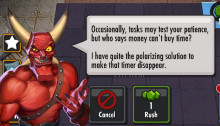
Let’s stick with the little purple diamonds for a minute. When you click to buy some, you’re presented with six different denominations you can buy, ranging from 900 diamonds for $100 to 35 diamonds for $5. Notice in the screenshot which of those options is selected by default, though: the most expensive one.

This is designed to take advantage what’s called the status quo effect, which describes our tendency to accept default settings, decisions, or options rather than make the often trivial effort to change them. This is especially true in ambiguous or cognitively demanding situations. For example, in one study,2 researchers were able to drastically increase the number of employees who participated in a savings plan just by requiring them to opt out of the program rather than opt in.

Similarly, more people shopping for diamonds should go with the default choice of 900 for $100. Of course, many of you may be thinking that this is too extreme to work in most cases; most people are looking to spend just a few bucks, not $100. And you’re probably right, but SimCity Social uses the status quo effect elsewhere as well. Whenever you have to confirm sending a request to another player via Facebook, the system automatically checks a box that says “Don’t ask again before sending requests to [NAME] from this app.” When you accomplish something in the game, it often throws up a notification that includes the ability to “Share Rewards” to your Facebook wall after you click “OK.” This is, of course, selected by default as shown in the screenshot above.

Read more about the status quo effect:

Sin #4: Artificial Scarcity

Sometimes we just want something because we soon won’t be able to have it. This is known as the scarcity effect. Consider a simple 1975 experiment by psychologist Stephen Worchel3 where researchers offered subjects a chocolate chip cookie from one of two jars. One of the jars had many cookies in it. The other had only a few. In reality, they were THE SAME COOKIES but people reported the cookies from the mostly empty jars as more delicious, more desirable, and more expensive. Just because they were more scarce, and our brains are wired to be averse to losing the option to have something once it’s available.

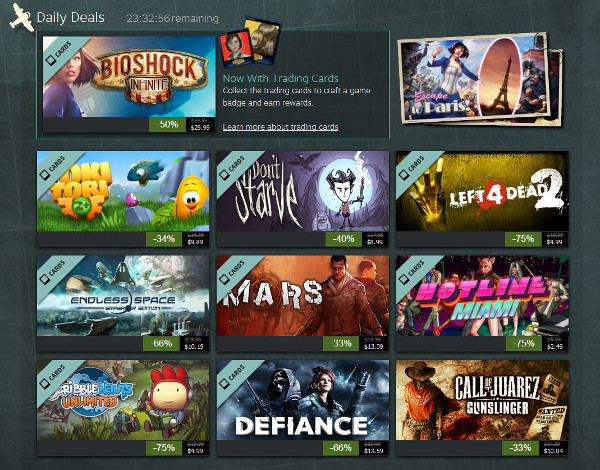
We see the same thing with plentiful goods or digital goods with limited time offer. If something is on sale for one day only, we’re averse to losing our chance at getting it for a good price and are more likely to buy it than we would if it were that same low price every day. Just look at Steam sales or Amazon.com’s deal of the day. SimCity Social creates this artificial scarcity by offering you a deeply discounted new building every time you level up. But you have to buy it RIGHT THEN before dismissing the “Level up!” notification –the text stresses “One Time Offer! You will NEVER see this offer again!”

Read more about scarcity:

Sin #5: Endowed Progress

Once we get started down the road to a goal, we’re reluctant to give it up. This is a great hack you can use to motivate yourself to reach goals, but it can also be used against you. And what’s more, it turns out that we’re super susceptible to suggestions that we have already started an undertaking, even right off the bat.

My favorite example of what’s called the endowed progress effect is a 2006 study by Xavier Dreze and Joseph Nunes4 where they gave half the customers at a car wash a rapid rewards card that required 8 total stamps to get a free wash. Others were given a similar card that required 10 total stamps, but were given two freebie stamps to get them started. So both groups needed only 8 more stamps, but the one that got kick started with the two freebies were more likely to come back for future visits and to wait less time between them.

SimCity Social leverages the endowed progress effect in a few ways. Upgrading building requires various resources, but you’ll often have at least some of these before you start and will thus immediately see something like “2 of 20 hard hats” when you check the progress of your upgrade. Each game chapter also has multiple, specific goals for completion (e.g., “Build a Bakery”) and I found that I had often already satisfied one of those goals in the course of messing around on my own.

Read more about the endowed progress effect:

Sin #6: The Availability Heuristic

The availability heuristic kicks in when we overestimate the frequency of event because instances of that event are easy to recall from memory –they are, in other words, more available for recall. (Interestingly, the converse is true as well; if we have difficulty remembering examples of something, we underestimate its frequency.)

Many things can make an event easier to recall from memory, including seeing it happen to friends. SimCity Social capitalilzes on this by encouraging you to spam the living daylights out of your wall with notifications of things that you’ve done in the game and the fact that you’re playing the game in the first place. Friends who see these notifications recall them more easily and are thus likely to overestimate the popularity of the game when they see an ad or receive an invitation to play.

Read more about the availability heuristic:

Sin #7: Benign and Malicious Envy

Social comparisons are, unsurprisingly, important to social games. This includes that old standby, envy, especially what’s been called “benign envy.” As opposed to “malicious envy” where you want to tear down the other person and take away their pretty shiny thing, benign envy is elicited when we think that a person deserves what they have because they earned it. Benign envy motivates us to improve ourselves (or pay money) to get the same rewards. In one study5 researchers instilled benign envy in a group of college students by having their friends earn a new iPhone. As a result, subjects said they were willing to pay 64% more to get their own iPhone.

SimCity Social capitalizes on benign envy when you visit other players’ towns. You can see everything they have built and bought. What’s interesting (and probably the most amusing thing about the game) is that you have the option to be either kind or mean to them as you click on all their stuff. You can “knock over display stands” in their stores, or you can “compliment the decor” when you visit their Mayor’s home. You can even send either hot air balloons across their skies, or a flock of incontinent seagulls. And, of course, if you experience benign envy over their accomplishments and layout, you may be more motivated to recruit more friends or buy some of those purple diamonds to keep up with them.

Read more about the benign envy:

So, there you go: my epic post on the psychological shenanigans of SimCity Social. I’m not saying Playfish set out to brainwash you –these are old design principles and the people who make videogames tend to be smart so they figure out and remember what works. Nor are they unique to SimCity Social, in that most of them apply in one way or another for most social games in this vein. But if you decide to engage in a little urban development on Facebook, everything above is good to keep in mind.

P.S., Thanks to readers Zachary and Danielle for stepping up and accepting the friends request to play the game with me and pose for some screenshots.

The Psychology of Diablo III Loot Part 4 Historical Items

Wait, did I say the series on Diablo III loot would be a three parter? By that I obviously meant it would have four parts. Don’t put words in my mouth.

I was listening to the always excellent Giant Bombcast podcast recently ((Seriously, you should be listening to the Bombcast every week; these guys are great.)) and the gang was talking about their experiences using the Diablo III auction house:

Vinny: I’d love to see how many times stuff is used. I want a pristine, new sword, I don’t want it used.

Jeff: How many owners has this thing had?

Vinny: Yeah. How many people has it touched?

Jeff: It’s a single owner, smoke-free home.

Vinny: They should definitely allow item descriptions. That’s the next thing, like little bubbles that are like “Get this amazing dagger right now! A+++”

Patrick: “Killed Diablo THREE TIMES!”

Brad: “Get the dagger used in a Hardcore, Inferno Diablo takedown!”

Ryan: Forget that, I want the Carfax. I want the owner history of this item. How many hands has this passed from? I want to know the mob that dropped it, the first guy that picked it up, if it’s been sold through the regular auction house or the real money auction house. I want to know that entire past. What’s the VIN on this axe? I don’t want some lemon.

You know what? These guys are totally right. Having this kind of history on an object –even a virtual one– would drastically affect auction house prices. Because history matters. A few months ago I was visiting Tulsa, Oklahoma ((Go Thunder or something? I dunno.)) and on a lark took my kids to the Tulsa Air and Space Museum. In the lobby there’s a big rock encased in plastic and settled behind a sign indicating its place of origin: the friggin’ moon. I stood there staring at this rock for a good 60 seconds, intrigued by its extraplanetary history. This despite the fact that the thing was virtually indistinguishable from any of the thousands upon thousands of rocks of similar size that I’ve seen in my life. If the sign in front of it had read “We found this out back. Woo!” I would have been baffled for a second before moving on, but this rock was special because it had once been on the damn moon.

Yale University psychologist and author of the book How Pleasure Works ((Bloom, P. (2010). How Pleasure Works. W.W. Norton & Company: New York)) Paul Bloom would understand. He notes in his book several ways in which the history of an object affects its value to us. This ranges from wanting a little more money to sell back a coffee cup we’ve only owned for a few seconds (c.f., the endowment effect) to selling a tape measure from the Kennedy household for $48,875, to the theft of Napoleon’s penis by the priest who conducted his last rights despite the fact he presumably had a perfectly good penis already.

Bloom and his Yale colleagues George Newman and Gil Diesendruck conducted a series of experiments to test what they called a “contagion” hypothesis –the idea being that an object’s value is affected by its history of contact with someone else. ((Newman, G., Diesendruck, G., and Bloom, P. (2011). Celebrity Contagion and the Value of Objects. Journal of Consumer Research, 38.)) As part of the study, they asked subjects to write down the name of a celebrity they admired (examples included Barack Obama and George Clooney) and then consider an article of clothing (e.g., a sweater, a pair of gloves, or a wristwatch) owned by that person. Subjects were then grilled on how much they would be willing to pay for that item versus an identical item from a non-celebrity. Unsurprisingly, people valued the item owned by the famous person more.

Nice stats

In subsequent experiments, though, the researchers drilled down into the phenomenon by tweaking the scenario. What if you were forbidden from reselling the item? That dropped the price a little, but honestly not much. What if the item had been thoroughly dry cleaned and sterilized after being used by the celebrity? That reduced the price people were willing to pay by almost one third. What if the celebrity had been given the item as a gift but had never actually worn or otherwise used it? According to Bloom, another study showed that this also drastically reduced the value of the item. What seems to be important here is that subjects felt the object had some kind of residue or essence about it because of its prior association with an admired celebrity.

Similarly, I think that if Blizzard were to enact the Giant Bomb crew’s suggestion of including historical information with auction listings it could really spike the prices on some equipment, though I think they have it backwards in that an item with a more interesting history would be more valuable. Would you pay more for a sword that has dealt over 15 million points of damage in its lifetime? Would you pay more for a helmet dropped by a champion mob with a particularly nasty attribute combination like Horde/Jailer/Mortar/ Teleporting? How about this off-hand power source that was only used by one little wizard on her way to church on Sundays?

No? Okay, let’s switch games and talk about World of Warcraft. Would you pay more to own the original armor worn by Leeroy Jenkins in that famous video?

Yeah, I would too.

Done? You can go back to go back to Part 1 about anchoring in the auction house, or back to Part 2 about the availability heuristic. Or back to Part 3 about dopamine and the auction house.

The Psychology of Diablo III Loot Part 3 Dopamine Binds On Pickup

In Part 1 of this series on the psychology of Diablo III loot I talked about how the anchoring effect can affect our estimates of value for auction house items. In Part 2, I described how the availability heuristic can trick us into thinking that epic item drops are more common than they are. In this part, let’s look at the interaction between the auction houses and loot drops, including a suggestion on how to reclaim some of the fun of the loot drop.

Instead of Tristram, let’s head to Sweden to begin. Wolfram Schultz was working there as a neuropsychologist studying Parkinson’s disease in lab monkeys when he almost accidentally started a line of research that ultimately suggests a way that Blizzard could encourage us to keep grinding for new loot. Schultz’s research involved dopamine and dopamine receptors in the brain. Dopamine is a chemical that’s released when we encounter something pleasurable, like a piece of fruit or a Legendary Mighty Weapon for our Barbarian. The chemical is hugely important for learned behavior and motivation to persist in a task, since when it’s released certain brain cells go bananas and make us feel good. Maybe even euphoric.

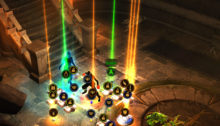
A yellow Rare drop? Ho hum…

What this means is that dopamine receptors are part of a system that’s about pattern recognition and figuring out how to get more good things out of life. Schultz and his colleagues discovered that presenting a lab monkey with a bit of fruit caused the creature’s dopamine neurons to light up. They also discovered that when they repeatedly preceded the treat with a light or a sound, the neurons would start to fire when the monkey saw the light or heard the sound, but then remain relatively inactive when the fruit showed up. The system they had discovered was, at its core, about anticipation and trying to predict rewards based on what was happening in the environment.

What’s more, it turns out that unpredicted gushes of dopamine really get us fired up. This is because unexpected dopamine rushes highlight failures in our predictive system, and it’s a system that’s designed to help us figure out why we didn’t see life’s good things coming and thus how to find them again in the future. This is why the random nature of loot drops in many games is so effective at getting us to keep playing: it capitalizes on our brain’s attempts to predict the unpredictable. (See here for more on dopamine and loot drops.)

Loot drops were indisputably core to the Diablo and Diablo II experience for all these reasons. Hearing the little “ting!” sound and seeing the beautiful, colored text indicating that a unique item had dropped produced a rush that every player looked forward to.

Only, not so much with Diablo III.

The reason is that the auction house is actually a FAR more effective but much more predictable way of finding better gear for your character than hoping for good loot drops from fallen enemies or treasure chests. In my experience it was super easy to buy equipment so good that the magical “ting!” sound soon lost its effect because the loot that dropped was no longer a reward. It was just gold in a slightly more inconvenient form, destined to be sold to a vendor or at best on the auction house for a little more. In effect, the auction house system excised the entire dopamine rush, loot drop appeal of the game. ((Yes, high quality items still mean big returns on the auction house, but the whole process of listing, selling, and transferring the money is too far removed to elicit the same dopamine rush.))

I suspect that the execs from Blizzard are too busy cackling and having money fights with the cuts that the company takes from real money auction house transactions to care, but this seems like a huge part of the game’s core appeal is now lost. I think there’s some middle ground, though, which is why I think the game should have a class of super items that are bind on equip.

In MMO parlance, “bind on pickup” or “BoP” items are treasures that bind to your character’s account once they’re equipped. This means they can’t be given away, sold, or otherwise transferred. You can just equip them, break them down for crafting materials, or just sit there and stare at them in your inventory. Finding a really good, color-coded item that’s BoP would restore some of that “ting!” feeling and dopamine rush, because it will be something that you won’t be able find on the auction house. Making the best items in the game BoP would go a long way towards creating those familiar dopamine rushes because they would signal a clear and strong reward, but even making them run the full range of quality would probably still work, since seeing one drop would signal the tantalizing possibility of something otherwise unobtainable. Suddenly, the loot drop would be back, baby.

So there you have it: three suggestions for tweaking Diablo III loot based on psychology. If you’re a game designer I’d love to hear your thoughts on these, especially if you’ve experimented with anything similar.

Done? You can go back to go back to Part 1 about anchoring in the auction house, or back to Part 2 about the availability heuristic. Finally, there’s a bonus part 4 about the effect of item history on auction house prices.

The Psychology of Diablo III Loot Part 2 Availability Heuristic and Loot Drops

In part 1 of this three part series, I suggested that Blizzard could move more money through its auction house economy if it sorted prices from high to low by default, thanks to the anchoring effect. All of those items still had to be found from drops, though ((Well, minus the ones that are crafted, but shut up shut up shut up!)), and that involves a lot of tedious grinding. And even though, sometimes it feels like rare drops are just too rare and will never happen. What can Blizzard do to keep us grinding?

There’s a setting in Diablo III that lets you see when someone on your friends list pops achievements. For example, when your buddy beats Diablo ((OMG SPOILARZ!!)) for the first time on Hell difficulty and earns the associated achievement, you get a little notification near the chat area, along with an icon. It’s a neat social system that I think could be expanded to make people keep grinding for super awesome Rare or Legendary item drops.

To illustrate why, consider a simple, 1973 experiment by Amos Tversky and Daniel Kahneman ((Tversky, A. and Kahneman, D. (1973). Availability: A heuristic for judging frequency and probability. Cognitive Psychology 5, 207-232.)) where they created a tape recording of 39 names. Nineteen of these names belonged to famous people, and the remaining 20 did not. When asked, 66% of the subjects were able to recall more famous names than non-famous, and the vast majority –80%– incorrectly claimed that there were more famous names on the list than non-famous.

The reason for that last result, the researchers argued, has to do with what’s called the availability heuristic. In short, it refers to the fact that to the degree that recalling instances of an event or class of things from memory is easy, we will judge them to be more frequent or more numerous. In his book, Thinking, Fast and Slow ((Kahneman, D. (2011). Thinking, Fast and Slow New York: New York.)) Daniel Kahneman digs even deeper into the phenomenon, arguing that it’s an example of how part of our mind (the eponymous “Fast” part) will slyly substitute an easier question (How easy is it to recall an example of this phenomenon?) for a more difficult one (How frequent is this phenomenon?).

Killed Maghda on Inferno? Happens all the time.

There are many factors that make an event or thing easier to remember. For example, it may have happened in a very dramatic manner, it may have just happened recently, it may have affected you personally. The availability heuristic is the reason people thought school shootings were more common right after the 1999 massacre in Columbine, Colorado. It’s the reason most people overestimate the divorce rate in highly visible Hollywood couples. It’s why you think the Xbox 360 “red ring of death” failure is more frequent after it happens to you.

This is why I think that the achievement notification in Diablo III is a good start. It makes the number of people getting the achievement seem larger because it happened recently and to someone you know. The same effect could be used to make players think that the upper tier of “Legendary” item drops are more frequent if they saw a notification every time it happened to a friend. This would motivate players to keep playing in the (perhaps inflated) hopes of getting a similar drop. Blizzard could also post similar notifications about crafting high-end gems or blacksmith items. Or cracking the 10,000 dps threshold for the first time. Seeing notification of these events will make them seem more frequent and thus more likely to happen to you if you just keep at it.

Done? You can go back to go back to Part 1 about anchoring in the auction house, or skip ahead to a discussion of what effects the auction houses have on dopamine rushes and loot hunting in part 3. Finally, there’s a bonus part 4 about the effect of item history on auction house prices.

The Psychology of Diablo III Loot Part 1: Anchoring the Auction House

Oh man, you all, I’ve been playing a LOT of Diablo III lately. ((click click click click click click click click click click click click click click click click click click click click click click click click click)) I’m sure that many of you who have played have been through the same scenario I have time after time. After running around avoiding AOE attacks, dashing in to rez fallen teammates, and swatting aside trash mobs, you and your co-players finally deplete some end boss’s health and immediately gather around the newly created digital corpse to answer that all-important question: did anything good drop?

In some of the most important ways, Diablo III is a game about hitting monsters with weapons until other, hopefully better, weapons pop out of them. That is, it’s a game where you try to maximize the outputs of a system through optimal combinations of your character’s skills and equipment. This puts acquiring new gear first and foremost ((Especially once you hit the level cap of 60 and start running Hell or Inferno difficulties)) but unlike previous games in the franchise this one complicates that process by having auction houses where you can buy and sell equipment so that killing stuff isn’t the only way to deck yourself out with phat lewts.

As is my habit I’ve been thinking about how different psychological theories explain our willingness to buy things in the auction house and grind for new equipment from in-game drops. The game’s developer, Blizzard, probably has two goals among others: one, to get people to spend their in-game gold to keep the game’s economy moving (or real money in the real money auction house), and two to keep us playing the game over and over again in order to find stuff the old fashioned way. In pursuit of these goals, I have three suggestions for Blizzard (or anyone else developing a similar system) based on well established psychological phenomena. Instead of dumping everything at once, I’ve split things into a series of three articles, the first of which follows.

Let’s look first at how Blizzard can inflate prices in the auction house to keep money moving through that part of the conomy.

To start, consider these two questions:

1. Is the height of the tallest redwood more or less than 1,200 feet?
2. What is your best guess about the height of the tallest redwood?

What do you think? These are questions that researchers ((Jacowitz, K. and Kahneman, D. (1995). Measures of Anchoring in Estimation Tasks. Personality and Social Psychology Bulletin, 21, 1038-1052.)) asked of some visitors to the San Francisco Exploratorium. Other visitors were asked a similar pair of questions, except that the first one asked whether the tallest redwood was more than 180 feet instead of 1,200.

Both limits are pretty extreme, in that 180 feet is obviously way too short for the tallest redwood and 1,200 feet is crazy tall. Nonetheless, the answers to the second question, which was consistent across both groups, were pretty amazing. On average, those who had been primed by the 1,200 feet figure said the tallest tree in the forest had to be 844 feet, while those who heard 180 feet off the bat thought the tallest had to be only 282 feet. These were all random visitors looking at the same trees; the only difference between the two groups was the figure in that first question.

This is a clear cut example of what psychologists call “anchoring,” one example of which is presenting us with a number to change our estimates of an other, possibly unrelated number. Simply seeing the numbers 1,200 or 180 caused people to anchor on that number and to then adjust their estimates of the tallest tree instead of picking a more sensible starting point. This kind of effect shows up everywhere once you know to look for it. It’s the basis of lowball sales pitches that get you to anchor on a low price and then negotiate up. It’s the reason why many fast food restaurants list bigger, more expensive drink prices first on their menu. It’s why the “But wait! There’s more!” brand of infomercials list absurdly high prices for their wares first before slashing them down for a limited time if you act now.

2 bajillion gold for a rare two-hander? Pffft. I won’t pay over …half a bajillion.

And anchors can still have an effect if they’re nonsensical or random. Behavioral economist Dan Ariely and his colleagues conducted a study ((Ariely, D., Loewenstein, G., & Prelec, D. (2003). Coherent arbitrariness: Stable demand curves without stable preferences. Quarterly Journal of Economics, 118, 73-105.)) where they used anchoring in an auction simply by having bidders write down the last two digits of their social security number at the top of their bid sheets. Those whose numbers ended in the 80s and above actually were willing to pay up to 346% more for things like wine and chocolates than were those whose social security numbers ended in the 20s or below.

This is why I think that if Blizzard wants more money spent in the auction houses, one way to effect this is to pre-sort the buyout prices so that we see the big fat numbers first in our search results. Even absurd ones like where that one numbskull obviously just held down the “9″ key for 30 seconds. Seeing larger numbers will prime us to inflate our estimates of what that item is worth to us. If Blizzard wanted to get really sly about it, the company could show you the most that an item ((Or similar item, given that attributes vary a bit across items with the same name.)) has sold for over the last 7 days.

Of course, savvy auction house shoppers can use this information to avoid the anchoring effect. Setting price limits in the auction house filters would mitigate it, for example. Me, what I typically do is set some price limits with the filtering tools, then sort by ascending price rather than descending. That way, I anchor on the low prices instead.

But what about getting loot the old fashioned way –by grinding for it? Read about that in part 2, or skip ahead to a discussion of what effects the auction houses have on dopamine rushes and loot hunting in part 3. Finally, there’s a bonus part 4 about the effect of item history on auction house prices.

Draw Something Uncertain

Imagine that some wealthy lunatic comes to you with an offer to choose between the following gambles in order to win five bucks:

Option 1: A stock is selected at random from the Wall Street Journal. You guess whether it will go up or down tomorrow. If you’re right, you win $5.

Option 2: A stock is selected at random from the Wall Street Journal. You guess whether it went up or down yesterday. No peeking! If you’re right, you win $5.

Would you have a preference? You know they both offer equal chances of winning, right?

Well, if you were like 67% of subjects described in a 1991 paper by Chip Heath and Amos Tversky published in the Journal of Risk And Uncertainty ((Heath, C. and Tversky, A. (1991). Preference and Belief: Ambiguity and Competence in Choice Under Uncertainty. Journal of Risk and Uncertainty, 4, 5-28.)) you would pick Option 1. The reason has to do with what the authors call “the competence hypothesis.” In short, they say “people prefer to bet in a context where they consider themselves knowledgeable or competent than a in a context where they feel ignorant or uninformed.”

If you know nothing about a situation, the outcome of any predictions you make –right or wrong– can be attributed to dumb luck. But if you’re supposedly an expert, you stand not to gain $5, but also self-esteem and bragging rights. Sure, if you’re wrong your ego suffers, but that’s only if you’re wrong. Ignorance, on the other hand, is always a liability –blind guesses are just lucky if they turn out to be right and only serve to highlight your ignorance if you’re wrong. So people prefer to make bets on something they think they know about and hesitate to make them on something they’re ignorant about.

Right, I know: You’re out there saying “Well, duh!” so loud I can hear you all the way up here in my ivory tower. Of course people prefer to make bets about things they know more about. But that’s not quite the point of this article and not quite what was happening in the stock betting scenario described above. It turns out that this bias towards betting in line with our expertise can result in some irrational behavior when we realize that something is knowable even though we don’t know it.

Toad, master psychologist and kind of a jerk.

In other words if something is knowable, like whether or not a stock went up yesterday, but not known to us at the moment, we automatically shy away from that bet. It’s habit and a bias. Just not knowing something that we feel we could know triggers feelings of lowered competence, which our brains use as a mental shortcut for identifying bad risks. In another experiment ((Rothbart, M. and Snyder, M. (1970). Confidence in the Prediction and Postdiction of an Uncertain Outcome. Canadian Journal of Behavioral Science 2(1), 38-43.)) half the subjects bet on the outcome of a simple die roll before it was cast, and half bet on the outcome after it was cast (but before they could see it). Those who were making bets prior to the roll were more confident of their predictions than those who were betting on an unknown roll that had already taken place. They were also more willing to bet money on the outcome ((Wait, were these psychologists running a craps game under the guise of scientific research? Man, I bet they totally were.)) Same thing. As Heath and Tversky say, “In prediction, only the future can prove you wrong; in postdiction, you could be wrong right now.”

I was going to guess something else, but no I see it now.

So, what does this mean for video games? For one, I’ve been playing the iPad game Draw Something a lot lately. It’s a drawing game where you’re given a choice of words in ascending difficulty (e.g., box, airport, Mad Men) and then you have to pick one to draw on the iPad using your finger or a stylus. The other player, through the magic of the Internet, sees your drawing but not the word it’s based on –that they have to guess from your work. The thing is, though, that they don’t just see the completed drawing. They see a recording of you going through the process of drawing it. Sometimes this is hilarious and embarrassing such as I screw up something simple like “pancakes” but generally it gives the game a much more “live” feeling and lets you guess at something before it’s done. Also, thanks to our bias towards betting on future events as opposed to past ones, I suspect that the “live replay” feature in Draw Something makes us more confident in our ability to guess a work in progress. Even though it’s technically already happened in the past.

What’s more, I think this bias informs ways that developers can design rewards or the sale of items in games. Imagine a player opening a treasure chest to get either an awesome or lousy piece of loot as a reward for clearing a dungeon. Alternatively, imagine a smarmy NPC saying “I put a piece of loot in each of these two chests. One is awesome, one sucks. Pick a chest.” Which would most players prefer, even though their chances of getting the good stuff are equal? The first, because it offers the illusion of betting on an outcome that hasn’t happened yet, and thus doesn’t trigger the bias described above.

Wait, I got it! Let's use a psychological hack to sell more Veteran Packs!

As a final (slightly evil) example of how to hack this bias into a game system, consider the supply crates in multiplayer Mass Effect 3. These are crates of essential goodies that players can purchase for either in-game funds or Microsoft Points. Opening a crate is like spinning a slot machine in that the contents are random within certain parameters –sometimes they’re just ammo packs and an upgrade for a gun you never use, and sometimes they unlock new character classes and outfit you with ridiculously powerful weapons.

Think about if, when you select a crate for purchase, the confirmation button read something like “Load this crate with a random X, Y, and Z and purchase.” Would giving players the illusion of betting on the contents of that crate before they are determined result in more purchases? I think it probably would.

Thanks a lot, brain.

Needs and Gratification Theory and Game Genres

Hey, do you guys watch Extra Credits? If not, you should. Each week the team there shares insightful, animated essays on topics related to video game design, culture, and business. They’re often pretty amusing, too. A few weeks ago they did a series on the difference between Western and Japanese RPGs that reminded me of a theory from the field of media psychology that aims to explain why we gravitate towards certain genres of entertainment.

In part 1 of the Extra Credits series the authors argue that the whole way we look at genres and sub-genres is inherantly flawed:

Most of the time when we talk about what makes a game belong to a certain genre we only talk about surface elements. The visible mechanics or dynamics of a game. This game is an RPG because it has a leveling system. That game is a first-person shooter because it has guns and a first-person camera. That other game is survival horror because there are zombies in it. But what we really outght to be looking for are the underlying reasons why we play a genre.

…Genres in all things are actually defined by what the audience desires to get out of interacting with them. We go to a romance for different reasons than we go to a comedy or a drama. We can identify a romance by the emotions it tries to invoke in us, not by its editing styles. And the same is true of games.

Let me ask you: Why is it we thnk of Mass Effect as an RPG even though its combat is built around third person shooting? Why are we so confident around labeling Call of Duty a first person shooter even though it has a leveling system? It’s because we’re assigning those labels not because of their surface mechanics or camera perspectives or techniques. But because of the fundamental human desires, emotions, and interests those genres deliver on; the underlying reasons we play which are radically different in these two cases.

…There are various different ways that games can engage us, which some designers refer to as “core play aesthetics.” Narrative, challenge, fellowship, discovery. And that’s just to name a few.

What James ((Mostly James Portinow, I think, who pens each episode’s script)), Daniel, and Alison are explaining here is called “needs and gratification theory” even though they don’t label it as such. It’s actually been kicking around the media psychology circles for decades, starting back in the 1940s when social scientists were interested in why men in fedoras chose to listen to radios dramas or read the newspaper over other activities. ((Ruggiero, T. (2000). Uses and Gratifications Theory in the 21st Century. Mass Communication & Society, 3(1), 3-37.)) Though the methodology and theory building improved, the core concept of needs and gratification theory has largely stayed consistent: We are attracted to media based on how well we expect it to satisfy internal needs.

In the case of television, consider Sally, who has a high need for intellectual stimulation and validation of her intelligence. Sally might prefer quiz shows like Jeopardy! because of how it meshes with these internal needs. Her friend Dick, on the other hand, is high in emotional intelligence and thus likes to ponder and understand interpersonal relationships. He would be more drawn to character driven dramas like Breaking Bad or even relationship driven reality television like Survivor.

The important point here to understand is that each person isn’t drawn to a show because the program guide labels it “Game Show” or “Drama.” Those are just convenient genre labels that Sally and Dick might use in the absence of other information. The point is that shows in each of those genres tend to satisfy different needs and we’re pretty good at noticing this kind of thing.

Mordin and Shepard have an existential crisis over whether they are in an RPG or third person shooter. Also genophage.


Due to the interactive nature of video games I think the needs and usage theory makes even more sense, though it hasn’t been empirically tested much. We are attracted to games because of the internal needs they help us fulfill. The Extra Credits examples of narrative, challenge, fellowship, and discovery make a pretty good list, though I would suggest additions like expression (for games that let you build, customize, and share), competition (for those games that facilitate comparing yourselves against others), and brain teasing (for puzzle games and word games).

For every one of those needs, you can probably think of a game that does an exceptional job of fulfilling it through its “core play aesthetics” to use the Extra Credits terminology. The main point of Skyrim, for example, is exploration. The main point of Minecraft is expression. The main point of SSX is challenge. Each of these games has a core play aesthetic that meets one basic psychological need that varies in intensity from person to person.

What’s interesting about this perspective is that it suggests that our current genre conventions are lackluster at best and flat our wrong at worst. Typical genre names like action, role-playing, adventure, and puzzle are widely used because games we’ve put in those genres tend to possess similar core play aesthetics –tend to but don’t always. Do you think if when you walked in to a big box retailer or browsed for games on Amazon you would have a better experience if the shelves and menus used words like Challenge and Narrative and Fellowship instead of “Action” and “Strategy” and “Role-Playing?” Do you think you’d be better able to find a game that you’d end up loving?

Needs and gratification theory suggests that you would.

The Dunning-Kruger Effect and Multiplayer Games

Let me describe a scenario that I think we’ve all been in. You pick up a game like Gears of War 3 or Starcraft II or the deck-building iOS game Ascension. You jam through the single-player campaign or do a little comp stomping in skirmish mode –maybe even on the second-to-hardest difficulty ‘cause you’re totally hardcore like that. And you’re better at the game than anyone on your friends list, judging by the local leaderboards and the way nobody will play with you anymore. You’ve got this game figured out, man, and you think you’re pretty good.

So you decide to venture online and try your hand at ranked ladder matches, a tournament, or maybe even just some pickup games via online matchmaking. You get creamed. Murdered. Owned. At the end of the match your competition has left you with a kill/death ratio in a realm of negative numbers so low that mathematicians hadn’t even bothered to really think about it yet because they figured nobody would ever use them. This baffles you, because by all previous accounts you’re totally awesome at this game.

Congratulations, you’ve encountered what psychologists call the Dunning-Kruger effect.

Named after the authors of a 1999 paper by Cornell University professor of psychology David Dunning and his then graduate student Justin Kruger ((Kruger, J. and Dunning, D. (1999). Unskilled and Unaware of It: How Difficulties in Recognizing One’s Own Incompetence Leads to Inflated Self-Assessments. Journal of Personality and Social Psychology, 77 1121-1134.)) the effect describes how those who really aren’t very good at something overestimate their skill while those who are experts tend to sell themselves short. The reason is that the more skilled you are in some complicated task ((Interestingly the Dunning-Kruger effect is more prominent for difficult, complex tasks and less so for simple, easy ones.)) the more you understand …that there’s stuff you don’t understand. Or that you haven’t mastered. Really good guitar players, for example, understand everything the instrument is capable of better than someone who has only now figured out how to bang out the beginning of that one Blink-182 song. Similarly, those of us who are really bad and inexperienced at a game often lack true understanding of what’s even possible. You can’t accurately reflect about your own opinion of yourself because you’re not good enough. And you’re not good enough because you can’t accurately reflect on your own opinion of yourself.

In their initial research, Kruger and Dunning gave students tests of logic, grammar, and humor (really, he had them evaluate the LOL potential of jokes from the likes of Woody Allen and Al Franken). When the researchers asked the subjects to guess at their performance on these tests, they consistently found that poorest performers overestimated themselves. Someone in the 12th percentile, for example, would guess that they were in the 62nd percentile. Further investigation showed that the poorer performing subjects overestimated their ability simply because they weren’t good enough to know how difficult the tasks were. And they didn’t know it.

I think I see this come up in video games a lot, especially ones with competitive multiplayer or even just those with challenges that let you compare your performance against others via leaderboards. It’s exacerbated by the fact that the single player versions of games often allow you to be incompetent in the pursuit of fun. You can soak up bullets in Gears 3 instead of using cover effectively or choosing the right weapon for the situation. You can brute force your way through a campaign scenario in Starcraft II using just Marines instead of appropriately countering the enemy’s army build. You can kite mobs around in World of Warcraft instead of using teamwork and assembling a set of equipment or list of perks with the optimal resistances. In each case, you’re frankly quite incompetent, but the limited feedback you’re getting doesn’t allow you to know it because you’re simply not that good at the game.

"LOL! Okay guys I played this level in the campaign! Just tell Liara to use Singularity until they're all dead."

Think of it in terms of known unknowns and unknown unknowns. I may not know the the melting point of Beryllium or the cooldown on an enemy mage’s frost bolt spell, but I know I don’t know that. But there’s also stuff I don’t know that I don’t even know exists or is a factor. Like what implications that enemy Sniper’s loadout has on my ability to sneak up and backstab him in TF2. The latter is the Dunning-Kruger effect in action. The great player sees every misstep and every missed opportunity for perfect play, and beats himself up over it. The novice bumbles along missing all that but getting the occasional headshot and thinks he’s doing all right for himself.

Some games are learning to address this fact by forcing novice players to learn the true scope of the game. Starcraft II, despite the fact that I’ve been using it to illustrate the Dunning-Kruger effect, actually tries to address it by inviting players to complete multiplayer-oriented challenges where they learn things like unit counters, defending against rushes, and other advanced tactics.This kind of thing helps, as well as curating of community guides and videos illustrating everything a game has to offer.

So next time you find your ladder rankings of your K/D ratio not living up to your expectations, take a second to reflect about all the things you don’t know and how your experiences so far may have been designed to make you feel more competent than you really are. Then go pick up some tips from those totally awesome hardcore players who know how totally awesome they really aren’t.

Two Lessons From Team Fortress 2

I’ve gotten sucked back in to Team Fortress 2 (TF2) lately and taking notes of the changes that have happened since I last played. In the course of poking around the Mann Co Shop I’ve been reminded that they have some pretty smart cookies over there at Valve and I for one welcome our new cookie overlords. Specifically, I’ve noticed two things in the store that capitalize on concepts I’ve written about here before.

For those of you who don’t remember, Team Fortress 2 is a class-based shooter that has gone free-to-play and supports itself through purchases in the Mann Co Store. You can buy different weapons and cosmetic items there, for prices ranging from just a few cents to …well, I’ll get to that in a second.

The first thing I noticed is that the store is now making an interesting use out of something called “the endowment effect.” I’ve written about it before, and the quick version is that once we feel we own something, we value it more. The classic experimental example was when researcher Richard Thaler gave subjects a coffee cup, then shortly afterwords asked how much they would be willing to sell it for. Relative to those who were not given a cup but instead asked how much they would pay for it to own it, those who already owned it placed a higher dollar value on the thing.

Now it's YOUR Backburner. Is it worth two bits to you NOW?

TF2 gets you to endow certain items from its store by letting you try them out, in game, for free. After seven days, the item goes away, but you’re given a chance to buy it. According to the endowment effect, people might value their new Backburner (level 10 flame thrower) more than they did before, and be willing to pay more for it. But Valve is nice enough and/or smart enough to know that they could probably really drive the bargain home by giving you a 25% discount on the newly tested item. So double whammy. You’re likely to value the item more, plus you don’t want to lose your chance at a discount.

Unfortunately Valve seems to only be doing this test drive system for items that are already pretty cheap –in the 50-cent range. I think they could get more use out of it if they let you try it with a few more expensive items. Maybe even put some kind of one-per-week limit on it to prevent doing too crazy, or reduce the test drive period for newer items. ((Or you know what? I’ve got pallates full of these ManCo Supply Crates that I’m never going to use because I’m not gonna pay $2 to play a TF2 lottery. I’d trade them for a test run of a new item.)) They could even capitalize on envious reactions from other players who see you using the new item.

And on the topic of “more expensive items,” we have our next psychology lesson from TF2. Here, look at this:

I know, right? Right?

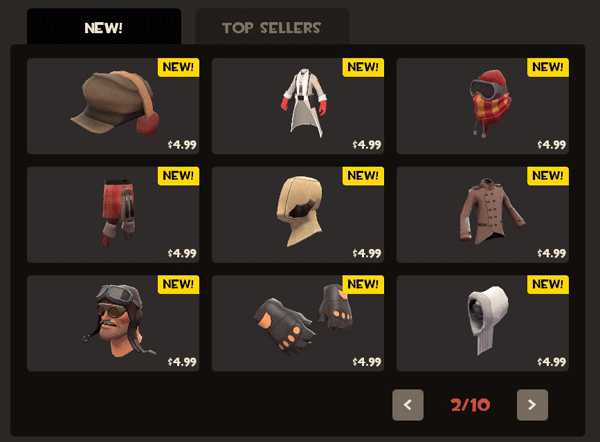
Yeah, you’re reading that right. You can now buy a virtual diamond ring in Team Fortress 2 that you can rename and then gift to another player. For $100. ONE. HUNDRED. REAL. DOLLARS. This boggled my mind when I first saw it, but then I realized that they besides cashing in on a few big spenders, the developers may be aiming to capitalize on an age-old sales trick: the contrast effect. Again, this was one of the first topics I wrote about for this blog, but the quickie version is that our perceptions of price (or more to the point, value) can be changed if we see a super high price ((Or a very cheap price, for that matter.)) off the bat. Retail sales people use this trick all the time by showing you a more expensive suit first, which makes the cheaper items two racks over seem a lot more affordable, let alone accessories like socks or belts. Ever poked your nose into an upscale clothing store and seen some absurd, $2,000 handbag on display up front? Who would pay that? Well, that’s not the point. The point is that it’s there to make the $200 handbags on the table next to it seem a heck of a lot more affordable –more so than if the super expensive item weren’t there.

Some people are witty AND rich! Too bad they're apparently already engaged...

This is what I think Valve is doing with the diamond ring item. Sure, letting you rename the item, give it to someone, and then broadcast that transaction to the entire Team Fortress 2 community –the whole community that’s online at the time, not just people on your server– will lead some people with more money than sense to have some fun like in the screenshot above. ((That’s a real screenshot I captured myself during a match, by the way.)) But I think the real benefit is that next to a $100 ring, that $13 hat for your Demoman looks a lot more affordable.

Self-Perception Theory and Marketing through Avatars

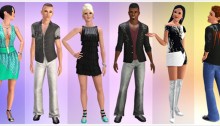
I recently found out, via this article on Mindhacks.com, about an interesting paper by researcher Jeremy Bailenson in The Psychologist. ((Balenson, J. (2012). Doppelgangers — A New Form of Self? The Psychologist, 25, 36-38.)) In it, he reviews recent research on how viewing online representations of ourselves –like our avatars on the Xbox 360 or our Miis on the Nintendo Wii– can affect our behavior. He talks some about modeling healthy behavior and implanting false memories, but to me the most interesting and possibly the most grim part of the article was where he discussed how to advertise products through avatars and by doing so affecting consumer behavior. Even if we know perfectly well that it’s happening.

Citing research presented at a professional conference, ((Ahn, S. and Balenson, J. (2011). Embodied Experiences in Imersive Virtual Environments. Paper presented at the 97th Annual Conference of the National Communication Association, New Orleans, LA.)) Balenson describes how he and a colleague blatantly Photoshopped subjects’ heads onto the bodies of actors in advertisements. One participant in the study, for example, might have viewed an image of himself holding up a particular brand of soda and smiling like a idiot as if to endorse it. After the study, subjects tended not only to remember the (fictitious) brands better, but actually indicated greater preference to them relative to other options. This despite the fact that they were pretty sure they had never drank “Blorf brand soda” or sat in a professional photography studio and posed for the advertisements in question. ((Interestingly, social/professional networking site LinkedIn is apparently taking this concept to heart and running an ad campaign where they insert users’ profile pictures directly into representations of a client companies’ recruitment literature in an attempt at getting people to apply for jobs there.))

Okay, I fixed the eyebrows. NOW how much would you pay for this stupid bird?

And this sort of thing may be thanks to what some psychologists call “self-perception theory.” In a nutshell, this theory refers to how we tend to look at our own actions to infer our own attitudes and beliefs. It’s kind of a “I’m doing X, so I must be the kind of person who likes X.” In one study ((Frank, M., & Gilovich, T. (1988). The Dark Side of Self and Social Perception: Black Uniforms and Agression in Professional Sports. Journal of Personality and Social Psychology, 52, 74-85.)) researchers dressed subjects in either black or white uniforms. Those in the black uniforms were observed to act with more aggression and toughness, keeping in line with their stereotypically villainous wardrobe. The researchers also argued (and showed with data) that this is why referees in professional sports are biased against teams that wear dark colors and are more likely to call penalties against them. Think of your avatar as a kind of uniform you wear (a notion supported by research, by the way), and you see the connection.

So, given all this I’m going to once again give out some evil ideas to those people in marketing. This kind of marketing-via-avatar thing could so easily be incorporated into video game avatars like those used by the Xbox. It’s not unusual for games to give out “avatar awards” for completing in-game actions. My little dude has a Locust mask from Gears 3, a sombrero from Red Dead Redemption, and a little Guilty Spark toy from Halo 3. Fun! But what if instead of watching my avatar play with a miniature RC Warthog I saw him chugging a can of Mountain Dew? Or perusing the latest issue of Wired magazine? Or gobbling fries from Burger King? According to the research described above, I’d be more likely to remember or even favor those brands over traditional advertising because there’s something psychologically important about seeing a representation of me interacting with them. Another study reported in the journal CyberPsychology & Behavior ((Bailey, R. Wise, K., and Bolls, P. (2009). How Avatar Customizability Affects Children’s Arousal and Subjective Presence During Junk Food-Sponsored Online Video Games. CyberPsychology and Behavior, 12(3), 277-283).)) found that “advergames” designed to advertise junk like Pop Tarts and Fruit-By-The-Foot snacks to children were rated as more enjoyable when they let the player customize his or her avatar.

Heck, we don’t even have to bury this kind of thing in the Xbox dashboard. I imagine games could easily pull our likeness in the form of our avatar ((Assuming, of course, you’re not one of those people who make ridiculous looking avatars that look nothing like you.)) and display them to us holding up boxes of Stay-Free feminine hygiene products or Kibbles ‘n Bits dog food while we wait for levels to load or matchmaking to happen.

Well, maybe those are extreme examples. But you’d think that game companies would at least start using this kind of thing to cross-promote games. If I were EA, I wouldn’t include a snowboard with a SSX logo as an avatar reward in that game. I mean, the customer has already bought that game, right? I’d include a N7 jumper from Mass Effect 3. That’s what you want your customers envisioning themselves playing at that point and that’s what you want them associating with themselves when that game hits the shelves. Or you can show them holding up a box of dog food. Your choice.