The Uncanny Valley and Character Design

Attention, Internet: I have a new article on the psychology of the uncanny valley up on gamesindustry.biz. You know what the uncanny valley is, right? It’s that theory originally from the field of robotics that says if you stick a couple arms and googly eyes on a trash can it looks cute, but if you don’t get facial animations or movement right on an otherwise realistic looking android it looks creepy as hell.

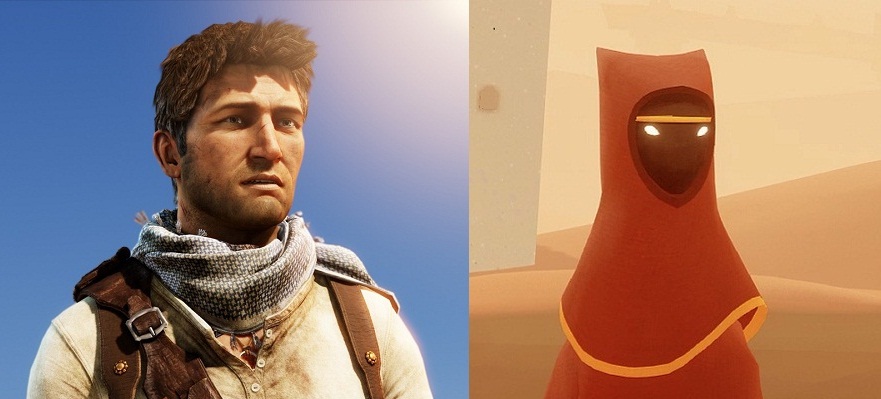
Nathan Drake and the traveler from Journey represent the two high points on either side of the uncanny valley.

Nathan Drake and the traveler from Journey represent the two high points on either side of the uncanny valley.

This has implications for the design of characters in video games, and the uncanny valley is sometimes cited as the reason why opting for more stylized character designs is a better choice –especially if you don’t have the budget and expertise to do tons of motion capturing and super high resolution textures. In the last few years some psychologists have done research on the underlying causes of the uncanny valley, and in my article I look at some of them and see what implications they have to say about character design in games.

I gave our friend Bobo the Quote Monkey a map of the uncanny valley and sent him off for a quote from the article. He came back looking a little freaked out and clutching this:

It shouldn’t be surprising that faces are one of the most important things determining whether or not a video game character will live in the uncanny valley.

One study by Karl MacDorman, Robert Green, Chin-Chang Ho, and Clinton Koch published in the journal of Computers in Human Behavior suggests this is true and provides some specific guidelines for those character creation tools we love to see in RPGs. In one of their studies, the researchers took a realistic 3D image of a human face based on an actual person. They then created eighteen versions of that face by adjusting texture photorealism (ranging from “photorealistic” to “line drawing”) and level of detail (think number of polygons). Study participants were then shown the 18 faces and asked to adjust sliders for eye separation and face height until the face looked “the best.”

The result? For more realistic faces with photorealistic textures and more polygons, participants pursued the “best” face by tweaking the eye separation and face height until they were pretty darn close to the actual, real face the images were based on. But for less realistic faces with lower polygons and less detailed textures, the ranges of acceptable eye separations and face heights were much larger. In a follow-up experiment the researchers did the same thing, except they asked the participants to adjust the sliders to produce “the most eerie” face instead of the best one. Again, when faces were more realistic looking, it didn’t take much tweaking to make them look creepy, but when the faces were more stylized and less detailed, a wider amount of facial distortion was acceptable before things looked eerie.

Read the whole article here. If you like it, please comment or share it on your social media outlet of choice.

The Psychological Appeal of Violent Shooters

I have a new article up on gamesindustry.biz exploring the psychological appeal of violent shooters via self-determination theory. I draw from work by Scott Rigby, Richard Ryan, and Andrew Przybylski that looks at how this theory of human motivation can explain why violent shooters are so popular.

Remember that skull in one of the Halo games that would make Grunts explode with confetti and a delightful "Yaaaaaay!" when you headshot them? Great indicator of competence.

Remember that skull in one of the Halo games that would make Grunts explode with confetti and a delightful “Yaaaaaay!” when you headshot them? Great indicator of competence.

SPOILER: It’s because good shooter design also happens to satisfy three basic psychological needs: competence, autonomy, and relatedness. Then to take things a step further, I looked at some research that tried to separate the “violent” from the “violent shooter” and see if these needs could still be met without all the gore, guns, and grunts.

I gave our simian friend Bobo The Quote Monkey a helmet, a rifle, and pack of Post-It notes. This is what he came back with:

So while RPGs might nail autonomy, platformers may demand competence, and MMOs may allow the most relatedness, violent shooters fire on all three cylinders.

“[Violent games] are fun not because of the blood and gore,” write Rigby and Ryan, “but because games of war and combat offer so many opportunities to feel autonomy, competence, and the relatedness of camaraderie rolled up into an epic heroic experience.” But, that all said, do shooters satisfy all these motivators so well because they’re violent?

It’s an important question, and Ryan, Rigby, and their colleague Andrew Przybylski published a 2009 study in the Personality and Social Psychology Bulletin that addresses it. Part of their research involved a clever experiment where they modified Half-Life 2 to create a high-violence version of the game’s multiplayer and a low-violence version. The high violence version is pretty much what you’d expect. The low violence one, though, was created by changing the bullet-spewing guns into “tag” tools that players would use to zap opponents. Once tagged, foes would freeze and float up into the air for a second before being harmlessly teleported to a “penalty box” where they would wait to respawn into the game.

You can read the whole article to see what the researchers found out.

The Psychology of High Scores in Edge Magazine

Did you find that last article on social comparisons and leader boards interesting? Really? Weird. Well, If you want to read more about social comparison, competition, and video games, you can do so in this month’s Edge Magazine, issue #243. It contains the last of my series of “Psychology of…” articles for them, The Psychology of High Scores.

Here’s what a relieved Bobo the Quote Monkey retrieved for us:

The second big thing game designers can do to make you feel more pleased with yourself and your performance is to make you feel like a big fish in a small pond. This is because people who are ranked near the top of a remedial group actually feel better about themselves than those ranked near the bottom of a higher performing group, even though the latter may be performing better than the former in absolute terms. Sometimes all it takes to make you feel like the smartest person in the room is to step into a closet full of dullards.

In fact, this so-called “big-fish-little-pond Effect” has been studied extensively in other areas, especially education where it has been found to be true in schools of all levels across 40 different countries. But it goes beyond that, because simply looking at your performance in the context of a smaller group tends to override any comparisons you may make with the world at large. For example, Ethan Zell and his colleagues Mark Alicke and Dorian Bloom at the University of Ohio split groups of 10 college students into two five-person teams and had them try to identify who was lying in a series of video taped statements. The researchers then provided each student with bogus feedback about their performance on this task (psychologists do this kind of thing all the time; in other contexts it would be called “lying” but here it’s known as “scientific research”) that indicated that they were ranked fifth or sixth out of the 10 people in the room. Some students, however, were given the additional information that they were either the best or worst performing member on their team of five. The researchers found that even if they were on the team that supposedly did best on the task overall, people had lower self-esteem than those who were the top performing on the losing team –even if they did better.

Big thanks to the folks at Edge Magazine for giving me the opportunity to write this series of articles. They were much more challenging and time consuming to write than these little blog posts, but also more rewarding and interesting. I hope to do more of these kinds of works in the future.

The Psychology of Game Nostalgia in Edge Magazine #242

Another of my articles on the psychology of video games has been published in Edge Magazine, Issue #232 July 2012. This time I wrote about the nostalgia we feel for good old games and how game developers and marketers capitalize on nostalgia to sell us reboots, sequels, and retro games. I have written about nostalgia before, but as is typical with the Edge articles I did a lot more research this time and investigated some additional ground.

For example, a lot of what I learned about nostalgia pointed towards how when we feel the emotion it makes us think about interpersonal relationships. I sent Bobo The Quote Monkey on his monthly fetch quest, and here’s what he got:

Nostalgia and social connections go hand in hand, then. Thinking about the loss of social connections, as nostalgia often makes us do, primes us to think about repairing those connections, maintaining current ones, or establishing replacements. Wildschut and his colleagues also found that when asked to describe nostalgic memories, most people recalled social contexts and good relationships with others. And research on the power of music has found that song lyrics emphasizing social relationships, including friendship, love, and familial bonds, were the most likely to induce nostalgia in subjects.

…You may reminisce about playing the original StarCraft, but the chances are you’re most nostalgic thinking about throwing down with friends in multiplayer or at least bonding with them over the shared experience of discussing how you managed the campaign. For gamers, our most nostalgic memories probably revolve around sharing the hobby with others, making new friends, and enjoying a good couch co-op experience.

That idea flows into something interesting that occurred to me about the nostalgia that today’s new gamers will feel years from now:

If nostalgia is tied so closely to social connections and a sense of community, games have the potential to evoke it more than any other medium, because they are so inherently social and are becoming more so every year. Early games might have been shared experiences on the couch or via playground discussions in much the same way as movies or TV, but the majority of new games coming out this year will feature mechanics or tools that encourage players to share, compete, communicate, help, and socialise. The same can’t be said of music, movies, TV, or other common vessels of nostalgia. It seems that games might someday boost more moods than anything else in history.

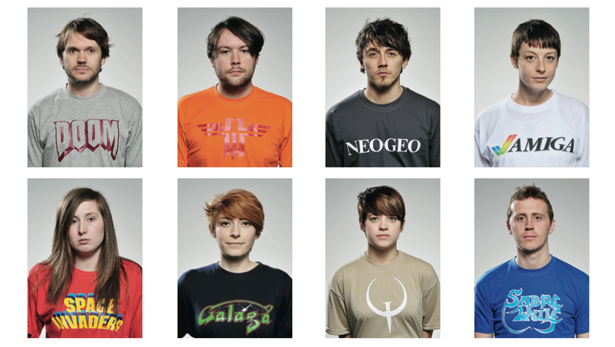
So, if any of that sounds interesting to you, check out the issue on either the news stand or via the digital edition. I’ll also note that I particularly loved the graphics accompanying this article. They took portraits of a bunch of people wearing tee shirts featuring logos from old gaming properties. There’s everything there from Crazy Taxi to Doom to Space Invaders. Just looking over those pictures made me nostalgic.

The Psychology of Genres in Edge Magazine #241


My latest article on the psychology of video games for Edge Magazine has been published in issue #241. It’s the one with the Crysis 3 cover. In it, I explore a bit about some theories of decision making and genre usage that may clue us in on why we like the genres we like. Why do we have genres, and are the ways that we think about game classifications doing us a disservice?

I sent Bobo The Quote Monkey out and he came back with this tidbit:

What factors make us more or less likely to depend on these mental shortcuts and compensatory strategies? It varies with expertise. Novices tend to substitute knowledge of a genre for knowledge about the specifics of a game. This is a widely studied phenomenon within the field of consumer psychology, especially in the context of brands. It’s been found to be especially true the less expertise we have with a product. In one study, C. Wahn Park and Parker Lessig found that people with limited experience buying microwave ovens tended to get overwhelmed with all the different options. Too many popcorn buttons and auto defrost settings were apparently too much for the novice buyer at the time to handle. What people who were unfamiliar with the product tended to do was collapse all the differences between options and consider them equivalent. So a microwave with seven power settings was lumped in with those only having five, because buyers were unable to put their fingers on why seven was that much better than five and how to weigh those factors when making a decision.

Instead, the subjects tended to look at things like brand and other aspects that the researchers termed “non functional dimensions” in order to make their price. Good experiences with a particular brand in another context was substituted for (or at least overshadowed) all the confusing technical differences, because that was easier and required less mental effort.

…It’s not difficult to see how this applies to video games and genres –or brands and series for that matter. Those who are less familiar with the huge variety of video games won’t understand all the technical aspects of the games. Asynchronous multiplayer? DirectX 11 support? Dedicated servers? Hours of gameplay? For inexperienced buyers who don’t make it a habit of reading magazines like the one you have in your hands right now, all those detailed, technical aspects of the game are going to get squished down to a few broad but shallow categories to make the mental strain of the decision easier.

The magazine is on store shelves now, if you’d like to pick it up. Up next month: The Psychology of Nostalgia explains (in part) why we have so many reboots, sequels, and retro games.

The Psychology of Avatars in Edge Magazine

I have a new article about the psychology of video game avatars in issue #240 of Edge Magazine. It’s this one:

Look for this issue with the subtle, easy to overlook green color. It blends right in.

This article was a lot of fun to write. My standard operating procedure is to look at some body of psychological research or theory that has nothing to do with video games, and then figure out how to apply it to games. Sometimes it’s a short hop in logic, sometimes it’s an inferential leap that requires a running start. For the psychology of avatars piece, though, I actually got to read up on research that was being done about video games, using video games and similar experiences (e.g., Second Life and virtual reality). There’s a lot of interesting stuff going on in this part of the field right now, and I enjoyed trying to sum up some of it.

Here’s a bit that our friend Bobo the Quote Monkey thought you might be interested in:

Researcher Nick Yee started his career by taking the precepts of social identity theory and using them to understand how people behave depending on the virtual avatars they assume. In one of his earliest experiments, Yee had experimental subjects don a wicked head-mounted display that let them perceive and move around in a simple virtual environment. There was just a virtual room, another virtual person controlled by someone else, and a virtual mirror. The mirror was important, because it obviously wasn’t a real mirror and the researcher could use it to show whatever “reflection” of the subjects’ avatars they wanted. In fact, Yee randomly showed subjects one of three types of reflections of their avatar: ugly, normal, and attractive.

What Yee was interested in was how this would affect how subjects interacted with the other person in the virtual room. After following directions to inspect their avatars in the mirror, subjects were asked to approach the room’s other occupant and chat with him or her. This other person was controlled by a research assistant and followed a simple script to get the conversation going, saying something like: “Tell me a bit about yourself.”

What the study revealed was how attractive a subject’s avatar was affected how he or she behaved. Relative to those with ugly avatars, people assigned attractive avatars both stood closer to the other person and disclosed more personal details about themselves to this stranger. Then, in a follow-up study using the same setup, Yee found that people using taller avatars were more assertive and confident when they engaged in a simple negotiation exercise. …Like in the real world, we first make an observation about our avatar, infer something about our character, and then continue to act according to our perceived expectations. We needn’t make a conscious decision to do it.

As usual, I demand that you possibly consider thinking about buying the magazine if you’re so inclined. I think it’s an interesting piece and I’m glad that Edge is willing to publish something relatively unusual for the world of games journalism. Also, my favorite thing about writing for Edge, which is a UK based magazine, is seeing that my editor for this article replaced the word “soda” with “fizzy drinks.” That’s absurdly charming for some reason.

The Psychology of Free-to-Play Games in Edge Magazine

Good news, everyone! Well, good for me and possibly good for you if you’re inclined to read Edge Magazine. Because my mutterings on the psychology of games are now appearing there. Specifically, I have an article about the psychology of free-to-play games in the latest issue (April, #239) with this cover:

Look for this cover at your local bookseller, news stand, and fishmonger.

The article looks at how two lines of research illustrate ways that free-to-play games may take advantages of human psychology to get us to cough up real money more than we may prefer. One way is by sapping our mental reserves and then appropriately timing sales pitches when our self restraint is taxed. The other line of research is how the different kinds of jealousy are better or worse and making us want to close the gap between us and other players who are showing off their new goods.

I flung the magazine and a highlighter to the ever faithful Bobo the Quote Monkey and here’s what he came back with:

Dr. Roy Baumeister and his colleagues pioneered this concept of “ego depletion” in a series of experiments at Case Western University. They had subjects exert self control by requesting they eat raw radishes instead of delicious chocolate chip cookies that had been left out on a table, and observed them through a one-way mirror. Some people looked longingly at the cookies or even picked them up to slyly sniff at them when they thought they were alone, but nobody bit into them. With these subjects’ mental reserves sapped by self restraint, the researchers had them engage in a series of problem-solving games. Relative to a comparison group that was allowed to eat the cookies, those who had to exhibit self control lost patience with the game and called it quits in less than half the time. In a follow-up experiment the researchers depleted their subjects’ self-control by having them suppress smiles while watching a stand-up comedy routine, and their findings in terms of how long this group would persist in a word puzzle game were similar.

What these experiments showed was that self-restraint takes something out of you, and with it gone you’re more likely to give up on boring or difficult games. It’s not difficult to see how the same could be true of game-based tasks that we’re all more familiar with, such as grinding out reputation points or taking the long way back to town instead of simply buying reputation ranks or fast travel spells from an in-game store. In fact, there’s evidence that this kind of ego depletion brought about by exerting self control can make us more susceptible to making impulse purchases.

It’s a neat article, and if you see the copy of Edge magazine in the store please pick it up and see if you think it’s worth buying. I’ve got more articles coming in future issues, and one of the neat things about writing for Edge is that they’re providing me with a lot higher word count to work with than GamePro did. ((No offense to GamePro, by the way, but it proved difficult to continue writing for them after they went out of business.)) This lets me flesh out the ideas a lot more and work in illustrative examples and quotes. The end result is longer, but it’s also more complete and I think more fun to read.

I Did a Podcast!

Well, I didn’t “do” a podcast as much as I appeared on one. This one on Quartertothree.com, to be exact. It’s a semiregular podcast put on by the folks at that website, where each week a member of their messageboard community sits in as a special guest. I talked about I-O psychology, Skyrim, the new Tony Hawk HD remake, MOBAs, Serious Sam 3, Star Wars: The Old Republic, and canned obituaries for the gaming industry. Also, my “game of the week” selection was Assassin’s Creed: Revelations, during which I tried to explain why I liked the game but was still disappointed in it overall.

Quarter to Three

I had a lot of fun doing this and it was fun to talk games with other folks. I’d love to do more podcasts, though I make no claims as to how good I actually was. If you want to hear for yourself, perform coordinated clicking motions here to access the QT3 podcast.

The Psychology of Immersion

By far, one of the most widely linked to and discussed articles I’ve written for this site is this one on immersion in video games. A while back I wrote an expanded version of that article for GamePro magazine where I focused more on new video game technologies, and GamePro.com has recently published it for your reading pleasure. Oddly, they put it up as a 25 meg pdf file. I’m …not sure why. But you can download it and see the whole thing for yourself, including nifty sidebars and artwork like this:

If this happens to you, do not panic. Perfectly normal.

Bobo the Quote Monkey was happy to have the work, so he sat through the download and fetched this quote:

The game world also needs to behave as you’d expect it to. “Consistency is the single most important factor in creating a real sense of place,” says Josh Foreman, an experienced designer at ArenaNet who works on the Guild Wars games. “The style can be anything from photo-real to abstract to impressionism, as long as there is an internal logic to what the player perceives.” This means that in-game characters, objects, and other aspects of the world should behave like their real-world counterparts.

…Interestingly, research is incomplete in this area, as it seems we’ll readily ignore some incongruous elements. Even the most engrossing movie is full of artificial jumps in time and cuts to different points of view, but we take these in stride. One researcher looked at what effects subtitles in foreign-language films had on creating presence and found that these words floating conspicuously in space beneath the movie’s characters were such an accepted convention that they didn’t hinder a feeling of presence. Likewise, players accept heads-up displays or damage indicators in video games with little damage to presence.

This article is different than the other GamePro pieces I’d written to date. I played around with the idea of introducing the article with a non sequiter ((Wait, can you START something with a non sequiter? I hope so, because I guess did.)) by talking about Cinerama. For those of you who aren’t movie historians, Cinerama was an early technology aimed at making movies more immersive, and I saw some interesting parallels between that and our modern day wide-screen TVs, surround sound, and motion controls. I think it kind of worked, and it’s an approach that I’m going to try to use more often when I have the space to do it.

Special thanks to Paul Harvey, Dr. Paul Skalski at Cleveland State University and Josh Forman from ArenaNet for providing input on the article. If you’re interested, the current print issue of GamePro on shelves now (the one with Twisted Metal on the cover) has a fun article on the psychology of loot drops. It involves monkeys!

The Psychology of Fear in Video Games

GamePro.com has published my article about the psychology of horror games, so if you didn’t catch it in the print magazine a while back you can now. IF YOU DARE.

What does this blood spot look like to you? Ink! I mean ink spot.

I sent a moderately frightened Bobo the Quote Monkey to fetch something from this article, and he came back with this:

Researchers say some people just have the right kind of personality for appreciating scares because they’re sensation-seekers attracted to any emotional high, be it from sky diving, shark-punching, or horror films. Other personalities are drawn to situations showing the disruption of social norms in ways that will probably never happen in real life.

But perhaps a more encompassing explanation of horror’s inherent appeal is how it helps us master our fears. This seems to be particularly important for youngsters, who flock to scary media as an ultimately safe way to exercise their emotional chops and deal with real-life scary stuff. “Watching a horror film gives us back some control,” Weaver says. “We can experience an adverse event through film, and we know that it will end. We’ll survive it. We’ll go on with our lives.”

Interestingly, this co-opting of horror only really happens if the player or viewer knows that what they see is fake. In one famous experiment, researchers had subjects watch a movie featuring authentic scenes of live monkeys having their brains scooped out and of children-I kid you not-having their facial skin peeled away in preparation for surgery. Just reading this probably makes you squirm a little, and the vast majority of the study’s participants refused to finish watching the films despite that more grotesque movies playing at the theater down the street could outdo those scenes. We seem to need to know it’s fake.

Bobo is having a lie down right now, but you can read the whole thing here.

By the way, if anyone from Viceral Games or EA is out there, you should totally send me a copy of Dead Space 2. I’ll write about why it’s scary. ((Or why it’s not, if it’s not.))