A Tale of Two Talent Trees

Can the presentation of choices on an upgrade screen or talent tree affect how we feel about those choices? Consider the two screenshots of talent trees below. No, look, don’t ask why just yet. Just consider them!

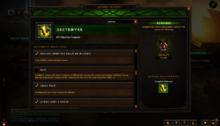
Syndicate_skill_tree

TR_skill_tree

The first one is from the first person shooter Syndicate while the second is from the latest Tomb Raider game. It may not be self evident from still screenshots, but these games handle the presentation of player choices differently. In the Syndicate tree, all your options are set out in one screen. Every time you have a skill point available you can mouse over any of those icons to get descriptions then choose the one you want. In Tomb Raider the choices are presented a little differently: you scroll from left to right through a sequence of skills at the bottom of the screen before deciding where to spend your precious point.

Which system, do you think, is more likely to result in commitment to and satisfaction with skill choices? Which do you think would be less likely to make players feel regret over their decisions and make them less likely to reload a saved game so they can make another choice?

A 2012 study by Cassie Mogilner, Baba Shiv, and Sheena Iyengar in the Journal of Consumer Research suggests that Syndicate’s system would be better, based on the metrics of likely satisfaction, commitment, and regret. It comes down to hope for a better alternative and the way our brains tend to process the sequential versus simultaneous presentation of choices.

In one of their experiments the researchers had subjects review a list of 5 different chocolate treats, including a description for each one –e.g., “Waikiki: dark chocolate ganache with a blend of coconut, pineapple, and passion fruit”. In one condition (the “simultaneous condition” or “Syndicate group” in my reckoning) all the chocolate names and descriptions were listed at once. In another condition (the “sequential condition” or the “Tomb Raider group”) participants scrolled through the names and descriptions one at a time before making their choice. Subjects then got a free sample of the confection –YUM!– and were told they were being entered into a lottery to win 25 more pieces.

Then, to get a feeling for how likely each group would be to abandon their choice right before going out the door, the experimenters offered to let them either change their lottery entry in favor of one of the other 4 chocolates they had seen, OR a mysterious sixth chocolate that they knew nothing about.

The results? Those who had seen their choices all at once were much more likely to stick with their original pick and rated their satisfaction with the choice much higher than those who were shown their choices sequentially. Those in the sequential group were twice as likely to switch their lottery entry to another chocolate, but the amazing thing is that they were almost four times as likely to switch it to the mystery chocolate.

The authors argue that invoking the emotion of hope in the sequential group is responsible for this finicky behavior and relative dissatisfaction with decisions. When we see all our possible choices, we know what we need to compare to what –it’s all right there. When, however, we receive one choice at a time, we get into the mindset of comparing each option to an ideal or potential (but not certain) better choice. In other words, we hope that the next one is better. This, in turn, triggers feelings of dissatisfaction with each alternative and ultimately on whatever alternative we settle on. Those little dissatisfactions carry forward and make us more likely to abandon our choices if we’re given a chance –especially for something that we think could satisfy our hope for something better.

While we’re on the topic, there’s one other time when this sequential vs. simultaneous presentation comes to mind: Amazon.com’s Lightning Deals vs. Steam’s holiday sales. Amazon will sometimes queue up hourly deals that go on throughout the day. The catch is that they don’t tell you what the hourly deals are going to be. This sounds to me like a sequential presentation of options for those of us without the funds to buy anything we want.

Free shipping on all orders that you start to regret one hour later.

Free shipping on all orders that you start to regret one hour later.

Compare that to the daily smorgasbord of deals that Steam dumps on you every day of their major sales events. Instead of a sequential list of deals that are dripped out, you get a fire hose of bargains all at once. Based on what I described above, which do you think would result in more satisfaction once consumers have made their choice?

You should have no regrets except that your wallet is now empty.

You should have no regrets except that your wallet is now empty.

Finally, game designers might look to hijack this effect and bend it to their own ends. Sometimes maybe they WANT to have players feel regret over a choice or have a feeling that things might have been better if they had made a different narrative or moral choice. In that case, designers might want to not offer all those choices in one menu or one dialog list. Maybe they would be better served by presenting them one by one and not giving players the option of backtracking. Little things matter.

Did you find this kind of thing interesting? Really? Well, who am I to judge? You might want to follow me on Twitter, RSS, or Facebook to see more.

REFERENCES

Mogilner, C., Shiv, B., Iyengar S. (2012). Eternal Quest for the Best: Sequential (vs. Simultaneous) Option Presentation Undermines Choice Commitment. Journal of Consumer Research, 39, 1300-1312.

The Availability Heuristic is Always On

One of the stories that’s making the rounds right now concerns Adam Orth, a (former) Creative Director at Microsoft who caused a ruckus by cramming his foot in his Twittermouth. He did so while weighing in on a potential “always on, always connected to the Internet” nature of Microsoft’s next Xbox console. The gist of his high crimes is that he supposedly looked down on those complaining about such a console feature, downplaying the significance of places where Internet connectivity is reliable and/or affordable.

Here’s the widely circulated screen caps of the conversation:

orthy

Setting aside the actual rumor, what I find interesting about this situation is a certain cognitive bias that seems to be on display in these comments, as well as in many of the surrounding debates I’ve seen on the ‘net. Orthy’s estimation of the number of people who have stable Internet connections and who should thus “#dealwithit” is probably influenced by the availability heuristic. Or rather, the UNavailability heuristic.

The availability heuristic is an old mental foible that I’ve written about before, and the short version is that the easier it is to remember of examples of something, the more prevalent, frequent, or large we think it is. But interestingly, the opposite is also true: will tend to think something is less prevalent or less frequent when it’s harder to remember examples of it. Various things make an event or a condition easier to remember, but they often include experiencing it ourselves, having seen it recently, or knowing someone who has.

My favorite example of this (un)availability heuristic is a hack created by University of California Los Angeles professor Craig Fox (2006) to boost his student class evaluations. Before completing the evaluation forms, Fox asked half the students to suggest 2 ways to improve the class (an easy task), then asked the other half to suggest 10 ways to improve it (a much harder task). Those who go quickly got stumped on the road to coming up with 10 improvements gave Fox higher course evaluation ratings than the others. Why? Because they misinterpreted the difficulty of recalling so many flaws as evidence that there were few flaws at all.

And so it is when most of us try to estimate how many potential Xbox owners have reliable, unmetered internet connection. Live in a city like San Francisco where you and all your friends have great connectivity, you’re more likely to underestimate how big a problem an always-connected device would be because it’s hard to think of times when you’ve had trouble getting online. On the flipside, if you have a sister who lives in a rural area with only spotty DSL or a friend residing in a country where they pay for Internet access by the minute, you’ll probably overestimate it. For stuff like this, don’t trust your gut. It doesn’t think in terms of statistics. It thinks in terms of stories and experiences.

Oh, also, don’t post to Twitter, Facebook, or any other public place about your employer or its products. That’s a bad idea, too.

REFERENCES

Fox, C. (2006). The availability heuristic in the classroom: How soliciting more criticism can boost your course ratings. Judgment and Decision Making, 1(1), 86-90.

Heuristics, Ho!

This pricing I just saw on Bioshock Infinite inspired me to make a quick note:

bioshock_infinite

This is just a nice example of what psychologist and influence connoisseur Robert Cialdini would call a “click, whirr” moment. Bioshock Inifinite is only discounted three cents here, but we’re so used to thinking that something is a good buy if its full price is scratched out and a “SALE!” price is written in red that our brains develop what’s called a heuristic –an effort saving mental shortcut.

Though even just a second of observation reveals that the discount is meaningless, that first impression has already been seized by the fast-processing part of your brain and it can subtly and subconsciously influence your perception of price. It’s an old trick.

The Zeigarnik Effect and Quest Logs

What do waiters in a 1920s Venetian restaurant and today’s average role-playing game fan have in common? They both tend to remember what they have yet to finish.

Sometime during the 1920s, Russian psychologist Bluma Zeigarnik was sitting in an Austrian restaurant (or maybe German; accounts differ) when she noticed something peculiar: waiters displayed an unusual ability to remember complex orders while they were being filled, allowing them to deliver the right combination of food to the right tables. But oddly, that information vanished from memory as soon as the eats were put in place (or maybe it was after the bill was paid; again, accounts differ). It didn’t seem to have much to do with sustained mental effort or chanting the incomplete orders under their breath to hold them in short-term memory. Instead, the orders that hadn’t yet been filled just seemed to nag at the waiters’ minds until they were checked off as complete.

Back in her lab, Zeigarnik pursued this idea and ran some experiments (Zeigarnik, 1927) involving the completion of various tasks or puzzles. Some of the subjects performing the tasks were interrupted, then everyone was asked to describe what tasks they had done. Like the waiters remembering what orders still needed to go to what tables, subjects were far more likely to recall the tasks they had started but hadn’t completed.

This “Zeigarnik effect” subsequently entered the psychology lexicon to describe how we tend to find it easier to recall a task –and the details surrounding it– when we feel like we have begun to undertake it, but been unable to complete it. Apparently we as humans don’t like it when we begin something and don’t finish it, and such circumstances create an internal tension and preoccupation with the task. Completing the task provides closure, release of the tension, and –not to put too technical a term on it– goodie feelie type feels.

Okay, before I leave this area I need to ...ah man. That's a lot of stuff!

When I played Skyrim, this is all I could picture at night when trying to go to sleep.

And we see this all the time in games, particularly role-playing games where in-game journals get crammed full of unfinished quests, errands, and tasks. Ever wring your hands over a huge list of incomplete quests or feel hesitant to progress the main quest until all those little side missions are checked off? To see the effect in action the next time you play a RPG try at the end of your gaming session to recall as many open quests as you can relative to completed quests.

And MMOs like World of Warcraft are the worst with this stuff, as anyone who has collected 13 out of 14 Goretusk livers can attest. Once we begin one of these tasks, they hang around in the back of our mind and are much easier to recall than completed tasks. Researchers Scott Rigby and Richard Ryan specifically call out the Zeigarnik effect in their book Glued to Games: How Video Games Draw Us In and Hold Us Spellbound:

MMOs are designed so that your list of tasks is never done. No sooner do you complete one, then two more pop up to take its place. Like a digital game of whack-a-mole, accomplishment only brings more unfinished business. As soon as you finish or “turn in” a quest, you are immediately offered another one with an even bigger reward. Or perhaps completion of one “unlocks” the opportunity to receive many new quests at once. Quests are often linked together in a series that helps move a story along, but never provides much closure. If I need to find 12 jewels to complete my quest, I will not stop at 11.

We also see this happen in empire building game series like Sim City or Civilization. The “just one more turn” is a direct result of the Zeigarnik effect, since that one more turn is almost always in the service of completing some structure, upgrade, technology, or conquest.

Familiar with the "just one more turn" phenomenon? Isn't it funny how it usually happens because you're waiting for some upgrade to finish?

Familiar with the “just one more turn” phenomenon? Isn’t it funny how it usually happens because you’re waiting for some upgrade to finish?

And researchers have continued to study the Zeigarnik effect and refine models associated with it. Schiffman and Greist-Bousquet (1992), for example, found that people over-estimated how long they spent on interrupted tasks, even when the time spent was the same as completed tasks (probably compounded by the availability heuristic, which causes us to overestimate how big or frequent something is based on how easy it is to recall examples of it). Other researchers have noted how the Zeigarnik effect isn’t completely reliable and have explored moderating factors like how motivated people are to do the task (e.g., Reeve, Cole, & Olson 1986), the nature of the interruption, or task difficulty.

But regardless of whether the effect shows up every time a task is interrupted, it does often happen. The next time you find yourself thinking “just two more turns until this research is complete” or “I just need to kill the trolls to make this quest log entry go away” remember Bulga Zeigarnik and her waiters filling orders for hot dogs and waffles. Or something. I honestly don’t know what they eat in Austria.

Reeve, J., Cole, S., and Olson, B. (1986). The Zeigarnik Effect and Intrinsic Motivation: Are They The Same? Motivation and Emototion, 10(3), 233-245.

Rigby, S. and Ryan, R. (2011). Glued to Games: How Video Games Draw Us In and Hold Us Spellbound. Santa Barbara, California: Praeger.

Schiffman, N., Greist-Bousquet, S. (1992). The effect of task interruption and closure on perceived duration. Bulletin of the Psychometiric Society, 30 (1), 9-11.

Zeigarnik, B. (1927). Uber das Behalten yon erledigten und underledigten Handlungen. Psychologische Forschung, 9, 1-85.

Modifying Player Behavior in League of Legends With Honor

One of the blind spots in my gaming experience is the multiplayer online battle arena (MOBA) genre, which consists of competitive multiplayer games like DOTA, Heroes of Newerth, and League of Legends. Part of the reason I’ve never jumped in to any of these massively popular games is the one-two combination of a daunting learning curve and their reputation as homes to hyper competitive and none-too-pleasant player communities. I don’t like the idea of doing the wrong thing and getting yelled at until I cry. It’s why I don’t go to elementary school anymore.

This hasn’t escaped the attention of developers, of course, and I recently learned from this article on Polygon.com about about efforts by Riot Games, makers of League of Legends, aimed at improving player behavior. Riot actually has a “Player Behavior Team” consisting of psychologists, human factors specialists, statisticians, and similarly educated folks who stand around in lab coats and experiment with ways to make League of Legends players act with greater sportsmanship.

LoL Honor

Did less than half your comments contain slurs against another player’s mother? Good job!

It’s a hugely complex problem, but Riot seems to be using a simple behavior modification trick straight out of Psych 101 to tackle it: operant conditioning through positive reinforcement of desirable behavior.

To wit, Riot recently launched a new Honor system to reward good behavior. After each match, players can give teammates and opponents accolades across categories like “Helpful,” “Friendly,” or “Honorable Opponent.” Points from these accumulate and are made visible in each player’s profile. Players are limited in how many Honor awards they can dole out, so getting one means something and Riot is experimenting with in-game rewards like special badges and player character skins for players who amass lots of Honor.

“The Honor feature was inspired by research on feedback loops and the psychology of learning,” Jeffrey Lin, Lead Designer of Social Systems at Riot, told me when I asked him about the psychological roots of the system. “One pillar of this research suggests that speed and clarity of feedback are catalysts that can really shape behaviors.”

Indeed, learning (which in psychology is often synonymous with “lasting behavior change”) via reinforcement or punishment dates back to research in the early 20th century by pioneers like Edward Thorndike and B.F. Skinner. In brief, they found that animals could be trained most effectively by pairing rewards or punishments with desired or undesired behaviors. Give a rat a pile of cocaine each time it presses a lever and it will jam on that thing like a maniac. But give the rat a pile of cats and it will stop pressing the lever. Or something like that; I’ll leave the specifics to the Wikipedia article on Reinforcement if you want them.

Research on this kind of learning developed and expanded, including its use in modifying human behavior and understanding the best ways to schedule and present the rewards and punishments. It turns out that positive reinforcement (adding something the subject likes, like Honor points) is super effective, but even more effective when presented unambiguously, meaningfully, and quickly after the desired behavior.

"IT'S CLEAR THAT YOUR PRACTICE IS PAYING OFF! I THINK THIS PARTICULAR SUMMONER SUITS YOUR PLAY STYLE! I LIKE YOUR SHOES!"

“IT’S CLEAR THAT YOUR PRACTICE IS PAYING OFF! I THINK THIS PARTICULAR SUMMONER SUITS YOUR PLAY STYLE! I LIKE YOUR SHOES!”

These lessons about specificity and timeliness of feedback for League of Legends players were taken to heart by the folks at Riot. “Knowing that speed and clarity are key,” notes Lin, “we opted to give players an extremely visible pop-up that clearly outlined the specific types of positive behaviors the player had engaged in immediately after each game. Instead of just showing that a player earned 4 Honor points we show the player the exact types of behaviors that they were Honored for.”

So timeliness and specificity are important to creating associations between behaviors and rewards, but there’s one other facet of the Honor system that I think makes it work: its feedback schedule –that is, how often you pair the reward with the desired behavior. For example, if you make the pairing every tenth time and that’s called a fixed ratio schedule. Do the pairing every ten minutes and that’s basically a fixed interval schedule.

But Honor in League of Legend isn’t given out according to either of those schedules. Rather, like a slot machine it’s essentially random since even if you behave yourself in a match you never know for sure if another player will give you Honor or not. But you learn that over time, if you exhibit good sportsmanship consistently, you’ll get Honor a lot more often. Turns out that random or variable ratio reinforcement schedules are among the most effective way to change behavior in the long term. (For more on why this is, see my article on neurotransmitters and random loot drops in World of Warcraft.)

This all begs the question, though: are rewards like Honor more effective than punishments like shame or even banning? At first blush it seems that the consensus is that rewards are far more effective than punishments. That’s the attitude shared by many child rearing guides, dog trainers, and management gurus, anyway. But in the literature review I did while writing this article, it became clear that there is actually still considerable debate about the topic, and a lot of it depends on the type of people you’re trying to change. A 2011 meta analysis (a kind of superstudy that combines data from many individual studies) by Daniel Balliet, Laetitia Mulder, and Paul Van Lange, for example, found that positive reinforcement and punishment are about equally effective for getting people to cooperate with others in social dilemma type games. Humans and human interactions are complex, it turns out, so there’s little room to be definitive on the topic.

What is clear, though, is that a combination of rewards and punishments can be pretty darn effective, so it’s nice to see companies like Riot using the stick, the carrot, and whatever else it can get ahold of. Plus, it changes the scorecard to make clear that winning a match isn’t everything that matters. Having a good experience is why we play games. As Jeffrey Lin at Riot explained it to me:

Consider a player that just had a poor game–everyone (including him!) knew that he was the worst player on the team. He’s feeling a bit down and is considering whether to play another match at all after such a terrible performance. Suddenly, he gets a pop-up after he leaves the game that says, “Hey, 2 of your teammates thought you were really friendly and 1 of your teammates thought you were a great teammate.”

That moment changes everything. Yes, you were the worst and your team lost, but it’s OK. Without the system, this player might have just logged off with a bitter taste in his mouth. Now, we’ve nudged the negative experience into more positive territory.

Multiplayer games are social interactions. Shouldn’t our behavior in them carry the same costs and rewards as it would anywhere else?

REFERENCES

Balliet, D., Mulder, L., & Van Lange, P. (2011). Reward, Punishment, and Cooperation: A Meta-Analysis. Psychological Bulletin, 137(4), 594-615.

The Walking Dead, Mirror Neurons, and Empathy

Oh man, have you all been playing The Walking Dead from Telltale Games? I have, and with every installment of this episodic game I’m newly impressed by how hard it yanks on my emotions. Like the comic that spawned it, the game is unapologetically bleak and its appeal comes largely comes from watching characters getting crammed into really bad situations from which some of them just won’t emerge –unless they do so groaning and hungering for brains. Like many horror stories it’s appealing the way a roller coaster is appealing. The characters are full of despair, heartbreak, anxiety, regret, and desperation.

Stop. Freeze your face. Did you catch yourself imitating Clem’s expression here, even a little?

And the amazing thing is that the game gets me to feel all those emotions too. I’m glad that it comes in monthly installments, because I need the time between episodes to recover. But why is that? By what psychological, neurological, and biological mechanisms do video games like The Walking Dead get us to not only empathize with characters onscreen, but also share their emotions?

For the answer let us start, as we so often do, with tiny Italian monkeys.

Years ago, neuroscientists in the Italian city of Parma were conducting experiments on macaque monkeys in order to understand the functions of individual brain cells. This involved inserting wires into the brain so that the researchers could detect activity in cells related to functions like grasping and bringing food to little monkey mouths. As researcher Marco Iacoboni notes in his 2008 book Mirroring People: The New Science of How We Connect With Others, stories of a particular breakthrough are varied and apocryphal, but most of them involve a monkey wired up and awaiting his next round of experiments. In walks a researcher, who then reaches out and grasps something of interest to the monkey like a piece of fruit or a big red button marked “ACTIVATE TO FREE ALL MONKEYS.”

Suddenly the researcher noticed that according to the equipment hooked up to the monkey’s brain, neurons were firing that were associated with grasping motions, even though the animal had only SEEN something being grasped. This was odd, because normally brain cells are very specialized and nobody knew of any neurons that would activate both when performing an action or when seeing someone else perform the same action. Yet here the monkey was, blithely firing neurons previously only associated with performing motor actions while just sitting still and watching.

Thus was the first observation of a mirror neuron in action, a brain cell set apart from many of its peers and which are also present in delicious human brains. It turns out that many researchers like the aforementioned Dr. Marco Iacoboni, Professor of Psychiatry and Behavioral Sciences at UCLA, believe that mirror neurons are important for our ability to empathize with things we see, like the plight of poor Lee and Clementine in The Walking Dead. “Mirror neurons are motor cells,” Iacoboni tells me via e-mail. “That is, they send signals to our muscles to move our body, make actions, grab a cup of coffee, smile, and so on. However, they differ from other motor cells because they are also activated by the sight of somebody else’s action.” For example, a mirror neuron for grasp is fired when I grab an Xbox controller, but also when I see my friend grabbing a controller. “By being active even when we do not move at all and simply watch other people moving, they sort of create an inner imitation of the actions of others inside us.”

Curious about exactly how this phenomenon works, Iacoboni and his colleagues conducted a study (Carr, Iacoboni, & Dubeau, 2003) where they used very expensive equipment to monitor the brain activity of subjects who watched images of faces expressing different emotions. As expected, mirror neuron areas activated when people saw the expressions, and so did the limbic system, a portion of the brain known to be related to emotions. In short, upon seeing facial expressions, mirror neurons fired as if the subjects were making those expressions themselves, then triggered activity in the brain’s emotional centers so that subjects could actually feel the emotion being imitated.

Iacoboni notes that this process “puts us immediately in ‘somebody else’s shoes,’ in an effortless, almost automatic way. This is why we get so immersed in the movies we watch and the novels we read.” When we see Lee Everett or any of the other Walking Dead characters grimace in disgust, our mirror neurons for grimacing activate as if we were making that expression ourselves. And because of that inner imitation, we actually DO feel the emotion to some degree and thus understand what the other is feeling.

I think this is one of the reasons why The Walking Dead is so good at eliciting emotions: it frequently shows us the faces of the characters and lets us see all the work put into creating easily recognizable and convincing facial expressions. And so it’s not the zombies that elicit dread in us. Instead it’s things like the face that Kenny makes when Lee tells him to make a hard decision about his family. “We spend a ton of time on the facial animations for the characters in the game,” The Walking Dead’s Creative Lead Sean Vanaman said when I asked him about this. “After writing the first episode we start to make lists of the type of things characters are going to feel in the story and then start to generate isolated facial animations to convey those moods and emotions. Those are then used throughout the game.”

But it’s not just seeing an expression and imagining ourselves mirroring it. In the 2004 study cited above, Iacoboni and his colleagues also had some subjects physically imitate the expressions they were seeing and the cascade of mental activity increased. This suggests that actively imitating expressions helps us better empathize and understand, and it’s part of a fairly established line of research called the “facial feedback hypothesis.” For example, in one 2005 study researcher Paula Niedenthal had two groups of subjects look at the facial expressions of other people One group, however, was made to hold a pencil between their teeth, which severely limited their ability to mimic the expressions they saw. The result was that those clenching the pencils in their mouths were less able to detect emotional changes in the faces they observed because the lack of mimicry short circuited their brain’s ability to replicate facial expressions, feel the emotions themselves, and then recognize it in others.

So, I suppose the moral of all this is that if you really want to get the full effect from The Walking Dead, don’t cover your eyes and peek between your fingers in a way that inhibits your ability to mimic the expressions you see on screen. Your mirror neurons don’t appreciate that when they’re trying to get your to replicate expressions of crippling, existential doom.

Did you find this kind of thing interesting? Really? You might want to follow me on Twitter, RSS, or Facebook to see more.

REFERENCES

Carr, L., Iacoboni, M., & Debeau, M. et al. (2003). Neural mechanisms of empathy in humans: A relay from neural systems for imitation to limbic areas. Proceedings of the National Academy of Sciences USA, 100, 5497-5502.

Iacoboni, M. (2008). Mirroring people: The new science of how we connect with others. New York: Farrar, Straus and Giroux.

Niedenthal, P., Barsalou, L., & Winkelman, P. et al. (2005). Embodiment in attitudes, social perception, and emotion. Personality and Social Psychology Reviews, 9, 184-211.

How Game Tutorials Can Strangle Player Creativity

Okay, let’s do one more article on creativity and games, based on this question: Is it better to hand hold new players through a game tutorial to teach them all the mechanics and intricacies of a game, or is it better to let them figure things out on their own?

The “tutorial level” has become so ubiquitous in video game design that it seems really odd when a game does not go to to painful lengths to make sure you get a slow, measured introduction to every single game mechanic, presumably so you don’t burst into tears over confusion about what the Y button does. For example, I started playing the game FTL (http://www.ftlgame.com/) earlier this week and while the game does offer a brief totorial and many tooltips, it expects a fair amount from you in terms of learning how to play the game on your own. My first half hour with the game consisted mainly of a steady stream of expletives and mutterings like “Why would I ever spend money on door upgrades?” and “Wait, why are all these rooms turning pink?” and “OH GOD! WHY IS THAT ON FIRE? WHAT FIRE? HOW FIRE? …WHAT DO YOU MEAN GAME OVER?”

FTL (or “Faster Than Light” for the cool kids) gives you a brief overview, then tosses you to the space mantis/slug/rock men and expects you to figure the rest out yourself.

Eventually, though, I got into the groove and realized that for a game like FTL, part of the experience should be experimenting with new things, paying attention, and learning how to maximize your chances of survival on your own. It’s not dissimilar to systems driven, sandbox games like Minecraft or Terraria in that way: they just dump you into a system and tell you that figuring it out is half the fun. (The other half is feeling superior to people who complain about it not being spoon fed to them.)

This all reminded me about another psychology experiment I learned about from Jonah Lehrer’s recent book, Imagine: How Creativity Works. In a 2011 paper impressively entitled “The Double-Edged Sword of Pedagogy: Instruction Limits Spontaneous Exploration and Discovery” Elizabeth Bonawitz and her colleagues set out to examine how different modes of instruction affect how creative people get in their exploration of a new system. And by “people” I mean “toddlers.” Yes, toddlers are people; I looked it up. And also by “system” I mean “toy.” Work with me here.

The researchers invited kids visiting a science museum to check out a new toy, except not in that creepy way that you hear about on prime time news shows. The toy was a crazy homemade contraption consisting of tubes that did different things like squeaking, lighting up, and playing music. It’s important that these functions were not obvious and required some experimentation to discover. For some children, the experimenter took out the toy and said something like “Woah, look my badass new toy! Check it out!” Then she yanked on a tube to demonstrate how to make it squeak and finished up with “See that? This is how my toy works!”

For other children, the experimenter took out the toy, acted like she was seeing it for the first time, then pretended to accidentally make it squeak. She then feigned surprise (children are very gullible, it turns out) and said something like “OMGWTF? Did you see that? Let me try to do that!” then made it squeak again. For kids in all conditions, the experimenter gave the toy to the kid and finished by saying “Wow, isn’t that cool? I’m going to let you play and see if you can figure out how the toy works.”

Picture of the toy, taken from Bonawitz et al. (2011).

So, the key points here are that the toy did multiple things, but only one thing (the squeaking) was revealed. For some kids it was explicitly demonstrated and for others it was serendipitously discovered.

What the researchers found was that relative to those in other conditions, children who were given instructions on how to make the toy squeak played with it for shorter amounts of time, did fewer unique actions with it, and discovered fewer of the toy’s other functions.

Now, I understand that most of you reading this are not toddlers, but I think this has clear implications for video games. Because when we are given a thing and told “here is how it works” that presentation tends to constrain the list of things that we consider doing with it. We explore less and are less creative. Our brains tend to take the paths of least resistance, and heavy handed demonstrations create a nice easy rut for our thoughts to follow.

It’s Minecraft. Figure out what you want to do.

Sometimes this is great, as with simple games designed around mastery of a few skills. But for games dependent on the interaction of multiple systems, options, strategies, or approaches, detailed tutorials may hurt the player and their long-term experience with the game. Booting up a game like Minecraft for the first time, blinking a few times, and then saying “Okay, what happens if I do …this?” is a great experience and facilitating that approach is central to the appeal of the game. Like the kids who were told “this is a squeaky toy, here’s how to make it squeak,” players who get their hands held through an hour of tutorials are being mentally primed to consider only what they’re shown. Accident, serendipity, and an occasional bit of rudderless flailing about are sometimes necessary for creativity and exploration.

REFERENCES

Lehrer, J. (2012). Imagine: How Creativity Works. Boston, MA: Houghton Mifflin Harcourt.

Bonawitz, E., Shafto, P. Gweon, H. Goodman, N., Spelke, E. & Schulz, L. (2011). The Double-Edged Sword of Pedagogy: Instruction Limits Spontaneous Exploration and Discovery. Cognition 120, 422-430.

Creativity, Puzzle Games, and Brain Damage

Have you ever encountered a puzzle in a game that utterly stumped you, then wondered why it seemed so trivially easy when you stepped away and came back to it after doing something else for a while?

I have, especially on a recent playthrough of an indie puzzle game called “QUBE” (http://qube-game.com/). For those not familiar, QUBE is a first person puzzle game (kind of like Portal) where you manipulate special blocks in the environment to solve puzzles and exit testing chambers. Different colored blocks do different things, and once you enter a room where multiple blocks come into play, the puzzles can get really tricky and require some real insight to solve. For example, in one area you cause a clear globe to roll down a slope towards a purple receptacle, and when the ball passes through a blue field it turns blue. The insight needed to solve the puzzle is that you need to get the ball to roll first through a red field, then a blue field so that it turns purple (red + blue = purple) to match the purple receptacle at the bottom of the slope.

Now click this to make it go here, then AH NO NO NO! NOT THERE! Start over…

I found some of the puzzles in the final stages of QUBE devilishly difficult because they constantly required you to combine the different game mechanics in new and unprecedented ways. The solutions seemed obvious in hindsight but I simply did not see them at all prior that “ah-ha!” moment.

That’s the hallmark of a good puzzle game, but upon getting stumped in games like these, people (myself included) will often immediately head to GameFaqs or YouTube to find the solution so they can get on with things. But QUBE doesn’t even have a story or any other kind of gameplay. The sole point of the game is to solve the puzzles, so I didn’t want to cheat. Instead I was reminded that when faced with a difficult problem requiring a creative insight we are often greatly aided by stepping away and doing something relaxing for a while instead of trying to brute force things and keep staring the puzzle down until we figure it out. The insight needed for the solution then often comes to us in the midst of a hot shower, during a relaxing walk, or in the moments right before we drift off to sleep. Adopting this strategy, I stepped away when stumped and eventually finished the game.

Weeks later I was reading Jonah Lehrer’s new book Imagine: How Creativity Works and discovered that psychologists have extensively studied this phenomenon and actually honed in on the neuroscience of it a bit. Lehrer cites a study by Simone Sandkuhler and Joydeep Bhattacharya where the researchers used electroencephalography (EEG) to measure the brain activity of subjects trying to solve riddles. They found that a reliable indicator of when someone was about to figure out a puzzle was a steady rhythm of alpha waves from parts of the brain associated with relaxation and free association, and much less activity from areas of the brain associated with attention and focussed thought. When people lacked sufficient alpha waves, they were less likely to solve the riddles, even when given overt clues.

I don’t understand. I keep doing the same thing and not getting a different result.

Lehrer argues in his book that this is an illustration of how different parts of our brain work –or don’t work– when it comes to creativity and problem solving. Creative insights come about when our minds can wander in a way that lets them to break free of assumptions and constraints to create unprecedented combinations of concepts. This results in the pattern of alpha waves cited in the above study. As such, highly focussed effort and attention are actually the bane of creative problem solving, since they activate parts of our brain like the prefrontal cortex that overemphasize what we think we know and censor possibilities simply on the grounds that they’re weird or supposedly outside the context of the problem. Too much focus can be a bad thing.

Take, for example, another study that Lehrer cites: Carlo Reverberti et al.’s 2005 examination of the problem solving prowess of patients who had damage to their prefrontal cortexes and who thus had difficulty concentrating and avoiding distraction. The researchers started by giving these subjects a relatively simple puzzle involving Roman numerals and math. I’m paraphrasing, but it went something like this:

Move any single line from the expression below to make it true.

IV = III + III

Many of you probably see that the answer is to simply move the “I” from the left of the “V” to the right of the “V” to make “VI = III + III” or “6 = 3 + 3.” More than 90% of the subjects got that one, similar to a group of control subjects without brain injuries.

But now consider a trickier one:

Move any single line from the expression below to make it true.

III = III + III

Chew on that one. Can you figure it out? If so, good work. Only 43% of control subjects got it right. However, 82% of those with deficient attention spans solved the riddle, seeing how you just have to rotate one of the lines from the “+” sign to make it another “=” sign so that the expression reads “III = III = III” or “3 = 3 = 3.” The subjects who had difficulty focussing their attention also had difficulty restricting their search for solutions and didn’t hold on to unstated assumptions like “you can’t screw with the operators in the equation.”

Remember how creative you had to get in Batman Arkham City’s Mr. Freeze boss fight?

And so it is with games like QUBE and games of its ilk. In one of the later levels the solution to a puzzle (spoiler alert!) where you shuffle blocks around in a glass-covered pit requires you to realize that you can manipulate the blocks in such a way that one of them gets launched up at the glass cover to shatter it and completely change the rules of that puzzle. And it’s not just puzzle games like QUBE or Portal. It could be a Zelda game where you have to figure out how to beat an end dungeon boss, an RPG where you load out different stats and abilities, a strategy game where you try different build orders, or a combat game where you try different weapons and loadouts. Relaxation and shoving your attention somewhere else are likely to help because of the different parts of the brain that they activate.

So next time you’re stuck, don’t go straight to GameFAQs. Take a walk, play with your dog, fold some laundry, or do anything else that lets you mind wander. Or I suppose you could try getting brain damage. Apparently that works, too.

Competition, Cooperation, and Play

One of the topics that’s conspicuously absent from this blog is that of the relationship between violence and video games. The short version of the reason why is that I think the issue is too polarizing and too much tends to get read into findings on either side.

Something I did recently find worth discussing, however, is a kind of inversion of that topic: does playing cooperative games make you less likely to be aggressive and more likely to cooperate with people outside of the game? A big tip of the hat to Wai Yen Tang over at the blog VG Researcher, who recently wrote about three recent studies that explored this topic.

The earliest of these studies was by Mike Schmierbach (2010), who was interested in how game mode (single player, coop, or competitive) affected aggression. He shoved subjects into rooms to play games of Halo on the Xbox either campaign solo, campaign coop, or Slayer mode. After playing for a while, the researcher gave subjects surveys that measured various cognitions and emotional states. One part of the survey involved a word completion task where perplexed respondents were given two letters –KI, DE, BL, etc.– and then asked to use them to complete any word they liked. If you wrote KILL, DEATH, and BLUDGEON then you got more points than someone who said KISS, DEAN, and BLOKBUSTER. Also, you’re a better speller.

Schmierbach found that, as expected, people who played a coop mode were far more likely to come up with non-violent words, which he took as evidence of less “aggressive cognition.” Other self reported measures of frustration and arousal (in the general physiological sense) showed similar results.

This is interesting, but like most people I’m generally more interested in actual behavior than simple internal thoughts or emotional states. Fear not, because this year has seen the publication of two other studies that follow the same basic reasoning as Schmierback’s research, but which actually look at whether people engage in more cooperative behavior after setting the controller down.


Both Greitmeyer, Traut-Mattausch, and Osswald (2012) and Ewoldson et al. (2012) had subjects start off by playing games like Far Cry, FlatOut, and Halo 2 in either a competitive or cooperative modes. One unlucky group of people in a control condition got to play Tetris and frown at each other. Both sets of studies then had players set down the controllers and take part in social dilemma type games (of the non video game variety) where they had the chance to either cooperate with other players or screw them over.

Ewoldsen et al. found that players who had played the coop video game were more likely to engage in “tit-for-tat” strategies where they would open by cooperating and then either reward or punish the other player depending on if they played competitively or cooperatively in turn. Such a gambit is a very common tactic for players looking to cooperate and maximize outcomes for everyone involved.

Greitemeyer and his colleagues took things a bit further and measured perceptions of things like group cohesion (or dyad cohesion if you want to be pedantic about it; I don’t) and trust between players. Again, after teaming up to do violence to some common foe, people felt more cohesion and were more trusting in the subsequent task. And it’s important to note that these were all violent games –they were just ones that could be played in a helping, cooperative context.

There are some interesting takeaways and ideas from this in terms of crafting your own gaming experiences and for developers looking to capitalize on these findings. One is that timing matters. These effects are typically short lived, so if you want to hit players up for things that require cohesion, trust, and cooperation do it right after they’ve collaborated or interacted with each other in a cooperative way. It’s the ideal time to ask them to do things like send/accept friends requests, bestow gifts, heal each other, join groups, trade items, and so forth. Just finished a quest in a pickup group or successfully defended a capture point with the help of a new buddy? That may be the perfect time to pop up a prompt to “Rate this player” or to trade crafting materials. Better than after one of you won a dogfight or shootout against each other.

Similarly, if you’re a player try not to let the fact that you’re competing against someone keep you from cooperating with them next round or accepting their friend request. They may be a pretty cool dude or gal once you’re wearing the same colored uniforms.

REFERENCES

Ewoldsen, D. R., Eno, C. A., Okdie, B. M., Velez, J. A., Guadagno, R. E., & DeCoster, J. (2012). Effect of playing violent video games cooperatively or competitively on subsequent cooperative behavior. Cyberpsychology, Behavior, and Social Networking, 15 (5), 277-280.

Greitemeyera, T., Traut-Mattauschb, E., Osswaldc, S, (2012). How to ameliorate negative effects of violent video games on cooperation: Play it cooperatively in a team. Computers in Human Behavior, 28 (4), 1465-1470.

Schmierbach, M. (2010). “killing spree”: Exploring the connection between competitive game play and aggressive cognition. Communication Research, 37 (2), 256-274.

Trials Evolution, Social Comparisons, and Second Place

Is it worse to come in second to last or second to first? I’ve been playing a lot of Trials Evolution lately and this question kept occurring to me as the results of my run at each track came up. Trials Evolution is a side scrolling, motorcycle driving game with a heavy emphasis on physics. Your controller triggers map to the bike’s throttle and brakes, but the real trick is using your left thumb stick to control how far your little driver dude leans forward or back. This, along with your momentum and how much gas you give it, will determine if you crash and eat it. Or rather, when you crash and eat it. Because not only are you going to eat it, you’re going to go back for seconds, thirds, and a hundred and fifths. It’s that kind of game, and it’s awesome.

Oh god, they’re right behind me!

Among the several things that the game’s developer, RedLynx, really nails with Trials Evolution is the social competition aspect. The game is replete with leaderboards and indications of how well you’re competing against others, and RedLynx seems to be aware that it’s more meaningful to compete against our friends and other people we know instead of strangers. This is one of the tenants of what’s known in psychology as “Social Comparison Theory.” First proposed by social psychologist Leon Festinger back in 1954,1 the theory has since been elaborated upon and expanded, but the gist is that we like information about our performance, and if we can’t get that information directly we’ll compare ourselves against other people to get the next best thing.

But not just any other people. One thing that researchers have determined pretty clearly is that we prefer to compare ourselves against smaller groups of people –the so called “frog pond” effect named, I think, after Dr. Antonio Frog and his work with motocross racers at of the University of Pond, Connecticut. Even better, we like to compare ourselves to smaller groups of people we know, because those comparisons are more meaningful and give us more information. This is why Trials Evolution is smart to show leaderboards consisting of people on our Xbox Live friends list by default. But you don’t have to wait until the finish line to compare your performance. Each time you run a track the game shows you where your friends were on their best run by moving a little dot with their gamer tag attached along the track with you. It’s amazingly effective –much more so than showing you a dot belonging to “xxXTrialzd00d42Xxx,” the world record holder for that track. Because he’d simply zip off past the right edge of your screen and not offer any kind of meaningful comparison.

So good job, Trials Evolution people. The thing is, though, that we can drill down even further because two neighboring leaderboard rankings are not always equidistant from each other, psychologically speaking. For example, I kept noticing that I was much more likely to try and shave off a few seconds and creep up a notch on the leaderboards if I was in either last place or second place.

A 2006 Personality and Social Psychology Bulletin article by Stephen Garcia, Avishalom Tor, and Richard Gonzalez2 explains why. They posited that our upward comparisons are predicated on the existence of a meaningful standard –the top. But other standards –such as the bottom– could exist as well. Furthermore, the closer we get to those standards, the more the social comparisons to others near them matter, and we are more inclined towards competition and less inclined towards cooperation with those in our way.

To test their theory, the researchers ran a series of 8 studies where subjects were asked to role-play the parts of business executives, philanthropists, poker players, or rock stars. The details varied a bit across studies in order to test various aspects of their theory and rule out alternative explanations, but in general they presented subjects with a chance to either cooperate or compete with a rival. If they choose to cooperate, they might benefit more than if they competed, but the rival would benefit more and come out on top in the rankings. For example, here’s the instructions that one group got:

Imagine that you are playing in a 1-day poker tournament with 500 players. For the final round, you are deciding whether or not to team up with one of your rivals. Strategy A: If you play solo, your tournament earnings will increase by 5% and your rival’s by 5% . OR, Strategy B: If you play as a team, your tournament earnings will increase by 10% and your rival’s by 25%.

Subjects were then asked what strategy they would pursue if they were ranked #3 in the tournament and their rival were ranked #4. What about if they were #6 and the rival was #7? #24 vs. #25?

The consistent finding across these studies was that people were more likely to compete when they were closer to a meaningful standard like being the top ranked poker player or being the CEO of a company ranked high on the Fortune 500 list. This despite the fact that cooperating would earn them more money in absolute terms. Interestingly, players exhibited the same irrational behavior in order to avoid being ranked too close to the bottom of the charts. Just like I would throw myself against the brick wall of the “Physics Factory” track in Trials when in second place on my local leaderboards –much more so than if I were in fifth or eighth.

Game developers could hack this phenomenon into their design if their goal is to inspire competition or make the choice to cooperate more meaningful. More finely diced leaderboards like what Trials offers is a good start, but to take things further they could plant additional goal posts along our paths so that it’s not just first or last place that we focus on. Crossing thresholds to be in the top quartile of overall scores would be one example, but I suspect that even just adding weird metrics like “Amount of damage done with the rocket launcher” or “Number of bunnies irradiated” would have some effect. And, above all, calling out to the player the fact that you’re SO CLOSE to hitting one of those milestones relative to a friend should cause them to grit their teeth and buckle down.

Games should be facilitating these social comparisons when they’re most meaningful, like when players are on the cusp of stardom or at the brink of ignominy. And for good measure, carve out some more things for us to be proud or ashamed of.

Now, if you’ll excuse me, I’ve got to beat my friend Tungholio’s score on Gigatrack.