So why do you think you choose to play the games you do? NO! WRONG ANSWER! Well, actually, you’re probably mostly right about that, but an recent article in Psychological Science1 suggests that your choice of games and your motivation to keep playing them may have something to do with how well they allow you to experience something deeper and more personal.
In the article, Andrew Przybylski (whose work I also cited in my article for GamePro on the appeal of shooters that’s sadly no longer online) and his co-authors hypothesize that we’re motivated to play video games to the extent that they allow us to sample our “ideal self characteristics,” especially when there’s a large gap between our ideal selves and who we actually think we are. This could help explain why people are attracted to games in a way that’s unique to the medium.
Przybylski and his colleagues tested this theory in a couple of experiments in which they had gamers self-report their personality (using a standard “Big 5” measure) in three contexts:
- As they think they are IRL
- As the type of person would like to ideally be IRL
- As the type of person they felt like while playing a certain game
They found that we apparently enjoy games most when they let us feel like an idealized version of ourselves (i.e., #2 and #3 above are similar), and that effect is greatest when there’s a big discrepancy with our ideal self and our perceived self (i.e., #1 and #2 are dissimilar). So if I fantasize about being a loquacious, extroverted type of person, I feel better about myself when I’m able to play a game that lets me do that even though in reality I get tongue-tied in public. Or if I strive to be a more conscientious master of details and micromanagement, I might prefer a real-time strategy game over a first person shooter.
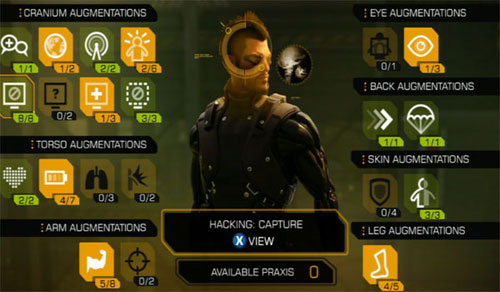
Hmmm... Should I put my augmentation points into Conscientiousness or Emotional Stability?
You may think this is a bit obvious, but I think some of the implications are profound for game designers, especially those working on role-playing games. We’re all probably familiar with the binary “Do you murder the puppy or do you help the puppy?” morality choices in some such games. Many of my favorite games in this genre include choices or developments that were much more complicated than that. Taking Przybylski’s research to heart, effective choices in these games are going to be the ones that allow let players adopt a much wider spectrum of personality, desires, values, and judgments.
I won’t share any spoilers, but those of you who have made it to the end of Deus Ex: Human Revolution will be familiar with a good example of this. It provides choices that allow you to have Adam –and through him yourself– weigh the importance of freedom, progress, purity, justice, honesty, and the like. Similarly, many paths in Dragon Age 2 ask you to create a persona that reflects varying emphasis on loyalty, dogmatism, anarchy, and justice. And while there’s something to be said about “playing the dark side” in these games for fun2 one could hypothesize that that kind of thrill comes most strongly from playing something equally complicated, just in the opposite direction from your ideal self.
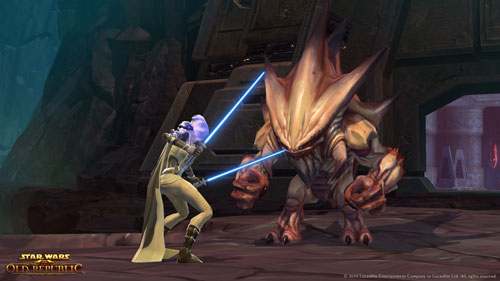
Okay, for extra light side points, kill this thing using only passive agression.
But there’s more. I haven’t played Bioware’s new Star Wars: The Old Republic MMORPG yet, but from what I’ve heard there are some improvements to that game suggested by the above research. In keeping with the Star Wars tradition, the game lets you play on either end of the “light side” or “dark side” morality spectrum. But as is with common with such systems, meeting certain thresholds of good or evil are required to use certain equipment and abilities. You get light or dark points by role-playing certain actions, so most players are on the lookout for ways to boost their standing. The problem with this is that it may not only over simplify the role-playing in the game, but by dangling a carrot from such choices the game may actively discourage players from exploring more subtle choices and consequences that let them feel more like their idealized self and thus motivate them to continue playing.
So, game writers take note. When you’re dreaming up your game’s stable of complex supporting characters, don’t leave the player character out of the action. We all love trying on different hats in the way that only video games allow, but some of us have very oddly shaped heads.


I don’t WANT to be the guy who brings up Minecraft in EVERY conversation about games, but I’m going to because I think it’s relevant.
I think that the the ability to ‘sample our “ideal self characteristics”’ is the heart of what people love about Minecraft. At least, I realized a couple months ago, that’s what I love about Minecraft. You see, I’m not a crafty person in real life, like, at all. If I try and do things with my hands, it looks like butt. BUT when I hop into Minecraft, I become one with Steve and Steve, it turns out, is a master builder and makes all kinds of awesome stuff.
I think that Minecraft, like few other games, allows players to recreate their perceived creative selves inside a game world to an uncanny degree.
Or maybe I’m just reading into things because I like talking about Minecraft.
That’d explain why my foray into Minecraft was… fleeting; I have no aspirations to be a miner/tool-manufacturer.
However, I’m pretty sure my ideal-self would be able to shout people off cliffs. Back to Skyrim I go…
Sticks and carrots
are very often in the way
taking away our true freedom
in character play
Let’s say you want to be a conscientious and rational Sith in SWTOR, that would probably cripple your “Dark Side”-rating.
In Mass Effect, if you don’t acquire enough Paragon OR Renegade points, after a while you don’t even get to make most of those decisions (which are very clearly coded by color and position). Only very few of the dialogue options are true choices. Mostly it’s just an old school dialogue tree that you go through to get all of the info out of that NPC.
The self expression in RPG games is severely limited imo.
I’m not convinced that the type of game is a representation of anything.
This argument was, i’m sure, made several years ago: by Richard Bartle, i think. However, since i first read it, i’ve never been able to find a reference to it again, so it’s good to have a refereed citation to quote now 🙂
1. I don’t hoard things IRL.
2. I wish I hoard things IRL.
3. A lot of games games I play, I play as a packrat.
Yup, fits!
Good writeup. I gave a GDC speech on the subject that some people might find useful: http://www.witchboy.net/articles/the-imago-effect/
I wish you would talk more about how some folks enjoy things in games like being totally rotten and killing puppies, because I don’t. This article kind of implies that most people wish they could kill more puppies in their idealized self, and all I can do is shake my head at that thought. Really?
I kind of think that the behavior is more about allowing them to act out feelings of hostility that they might have which otherwise has no outlet. Because people frequently feel hostility for others for which there are few acceptable outlets for that hostility.
Think Mr and Mrs Smith, for example.
Pingback: Super.licio.us | Superlevel
I think you are entirely correct in your assessment of the flaws of a “carrot” system like Light/Dark Gear in SWTOR. Many of the choices and consequences reflect the values of the game developers and/or Lucas, then in-effect penalize the player for making willy-nilly (but fitting their Ideal Selves) choices within that system. There has been a clamor for a “neutral” gearing system from quite a few fans. I suppose you could ignore the light/dark gear sets. Hmm Maybe I should look to see if the gear is worth it, in terms of “look,” since supposedly they offer no statistical benefit.
Pingback: True to Design: What I’m Reading « Managing the Game
Pingback: Beutestücke der Woche: Cello Wars, Skyrim Diebesgilde, Retrode, Mario Sterne und Lunch Tüten | Ninjalooter.de
Extra Creditz (which everyone should be watching, ’cause it’s great) did a nice piece on how this all applies to Mass Effect 2. Well, I don’t think it was their intention per se, but they address the “Renegade/Paragon” split as it relates to our ideal self in choices.
Link: http://www.youtube.com/watch?v=_2Tp8JopdIc
Is that Psychological Sciences paper available to the public somewhere?
Not for free that I know of, but you can go to http://pss.sagepub.com/ and purchase access to it.
Pingback: Psychology of Video Games + Cracked Article = Insight | Memo-Random
Hmm, how well does this apply to my game-playing?
Well, in Creatures, I am a mad scientist. I can tinker away, doing any experiment I want, without concern for ethics. Before I knew how impossible it would be to get ethics approval for it, I was literally planning to make mythological creatures through genetic engineering. In class when we were asked what we wanted to be when we grew up, I replied ‘mad scientist’. So that fits.
In World of Warcraft, I’m not exactly an RPer, but I do think up personalities and motivations for my characters, and act them out.
My undead rogue Joserna is fiercely loyal to Sylvanas, very pragmatic, somewhat of a loner, and likes collecting rare treasures (jewelcrafting and archaeology). She hates ‘honor before reason’ types and is quite willing to suck up to someone to gain an advantage.
My blood elf mage, Brays, is defiantly proud, likes magic because it makes her feel powerful, but at the same time she thinks about moral issues and feels conflicted a lot of the time. In Shattrath, she was saddened by how they essentially recreated the Horde vs Alliance conflict with different players.
My undead priest, Abigaira, tries very hard to be a good person, but she doesn’t really remember what ‘good’ is. She tends to play to the stereotypes of good (healer, holy magic, grinding rep), and when she lets her hair down and enjoys herself, she’s mind-controlling people, making horrific concoctions and turning into a being of shadow.
My night elf druid, Shadonreith, was raised by dwarves (I ran off to the dwarf starting zone). She’s a very playful, silly person who loves turning into animals, playing around in holidays and dancing (in animal form, because the night elf female dance sucks). However, as an interracial adoption, she feels a bit out of place. She doesn’t fit in among elves because she doesn’t think like them, but anywhere else she’s treated as an elf. She’s finally settled into just thinking of herself as ‘Alliance’ rather than any one race.
My blood elf death knight, Tanedratha, feels sad about realizing her mind-controlled perception of Arthas was wrong. But she doesn’t much like the Ebon Blade, either, because they think the only purpose for a death knight is revenge. She tends to cope by pretending to be someone she’s not (questing in low-level zones claiming to be a living elf of unspecified class). She can let her hair down and be herself with the Forsaken, but feels that just sticking with undead is playing it too safe, so she keeps venturing out to the rest of the Horde.
Most of them are pretty far from my ideal self, but they’re all possible selves if you tweak one or two things about me, and allow me to express some of my feelings. But I suspect with WoW it’s more about being creative and designing an interesting character. Partly because it’s less free – partly my characters are forced to be a certain way by the quests they take on, which is forced by the zones I decide to quest in.
Pingback: Super.licio.us | Superlevel