How are loot-based games like World of Warcraft, Torchlight, and Borderlands related to slot machines, chemical bliss, and evolution? Read on for the answer.
During my early days with World of Warcraft (WoW) I remember tromping through Westfall killing crowds of Defias bandits when I was shocked by a loot drop: a rare pair of “blue” gloves that perfectly fit my class’s needs at the time. For those of you who don’t know, killing enemies in WoW gives you a random chance at one or more pieces armor, weapons, or other items called “loot” in WoW parlance. These are stratified according their text’s color: gray, white, green, blue, purple, and orange in order of increasing quality. For a level 20-something character to find a blue item on a random enemy was actually very rare, and I experienced a huge rush from it. But more importantly, with that came an acute desire to keep playing the game and to murder more Defias bandits.
Other games do this, too. Borderlands gives you random guns from drops or chests, which compels us to check EVERY container, vending machine, and item dropped by felled enemies. Torchlight essentially uses the WoW system, and you can bet your thumbs that the upcoming Diablo III will push it even farther. But why are gamers so susceptible to the loot hunting addiction found in these games? Why is this gameplay mechanic so incredibly effective in getting us to keep playing?
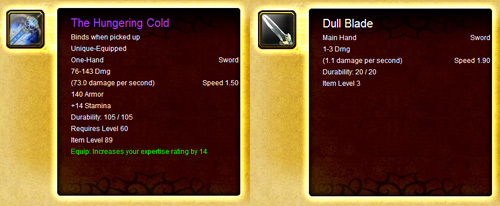
Which of these do you think would create a bigger dopamine neuron freakout if it dropped in front of you?
To answer that question, let’s consider slot machines and a type of brain cell called “dopamine neurons.” The latter are the bits of your gray matter responsible for monitoring levels of the pleasure-inducing chemical dopamine in order to regulate behavior and figure out how to get more of a good thing. It’s these cells that light up when something nice happens in your life (say a delicious Hot Pocket or a fuzzy puppy belly) and triggers a gush of the neurotransmitter dopamine. But what’s more, dopamine neurons play the role of trying to predict the rush from nice things, and they may fire before you actually encounter them. Given a couple of chances, they’ll learn to light up when you hear the microwave timer beep that precedes your delicious Hot Pocket. This is a pretty useful thing as far as evolutionary advantages go, since it clues you in ahead of time that something good is in the vicinity.
But this is only part of what makes loot-based games work so well. The real key is that while dopamine neurons fire once your brain has figured out how to predict an event, they really go nuts when an unexpected, unpredicted gush of dopamine shows up, giving you an even bigger rush. It’s like DUDE! UNEXPECTED HOT POCKET! Again, I’m guessing that this is an evolutionary advantage that causes us to obsess over unexpected pleasures and try to predict them so that we can get more of them.
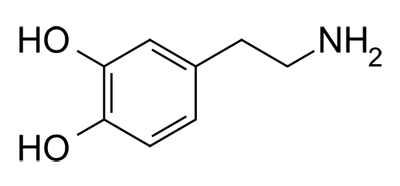
This is either dopamine or a map for the optimal arrangement for dps and off-tanks in some raid encounter.
But we can’t predict the inherently unpredictable. This is how slot machines get you. Your dopamine neurons are trying really hard to learn what precedes a jackpot in terms of what bells, you hear, pictures you see, or even which cocktail waitress last walked by. But in reality, it’s utterly random and by definition can’t be predicted. More rational parts of your brain may understand this, but not the dopamine neurons. They’re stymied, but that doesn’t stop them from flaring up and saying “HEY! THERE’S SOMETHING HERE! KEEP DOING WHAT YOU’RE DOING UNTIL WE FIGURE OUT HOW TO MAKE IT HAPPEN AGAIN!” So you keep playing.1
So, getting back to World of Warcraft, just replace “slot machine jackpot” with “phat loot drop” and you should have a pretty good idea why the loot game mechanic is so successful. Like all the best motivators, it uses a core concept of psychology as a lever to keep you playing and paying. But like with the slot machines, you DO have the ability to understand what’s happening and put a stop to it.
On the other hand, those blue gloves were pretty sweet on my Hunter. Maybe if I had killed a few more Defias bandits I could have gotten the matching leggings…


Pingback: Phat Loot and Neurotransmitters in World of Warcraft « The … | World of Warcraft
Pingback: Phat Loot and Neurotransmitters in World of Warcraft « The … | World of Warcraft Private Servers (WoWps)
Pingback: The psychology of a gamer’s search for phat loot | The IT Chronicle
Hi, saw your article from Joystiq.com.
I recently went to a casino and noticed that many people caress/wave their hands over the electronic slot machines. I never saw this before on previous casino visits. Alotta people really believe you can just somehow “will” the machine into giving out money apparently. Kinda scary 🙁
Pingback: Facternet.com - Web Hosting, Website Design and Internet Services for Small Business - The psychology of a gamer’s search for phat loot | facternet:
Yeah, there’s a whole weird world of rituals and other behaviors people employ to try to control random events. I wonder if people do any of that before dropping a raid boss?
I think one parallel that can be drawn in gaming is the various different button presses people employed when trying to capture a pokemon in any of the pokemon games. Just a thought.
Pingback: The psychology of a gamer’s search for phat loot| The Game Blog | Daily Fresh News of the Latest Games on Playstation, Xbox, Wii and PC| Coeds.cc
@ Jamie Madigan
Yes. For a long time there was a persistent rumor that each raid instance had it’s own random number generator and it was seeded by a) the first letter of the raid leader’s name, b) the raid leader’s class, c) whatever. It was ludicrous and publicly stated to be false by Blizzard but I still saw raids where people passionately argued for changing the raid leader to change the loot drops.
Human beings are exceptional at detecting patterns in seemingly unrelated events, and that skill has served us well. However, when faced with truly random behavior our tendency is to see a pattern where there is none. Raid leader names, slot-machine gestures, lucky baseball socks, etc, are all the result of overactive pattern-matching.
Pingback: Phat Loot and Neurotransmitters in WoW | Polychromatic Thematis
Hi, Thank you for posting this interesting article
I have found via http://xbox-mag.net.
I am a psychologist to understand the psychology of gamers. I am not plying myself. I wonder if there are some gender differences in dopamine release?
Also what is the biological profile of winners: is that the testosterone level ? What about those plying most hours a day (night: )?
From when can someone say being dependent ?
He doesn’t know.
I disagree with the main thrust of this article. Any serious WoW player is not in for random drops, and the analogy of comparing WoW to a slot machine is a very shallow one. The majority of most WoW players put their time into raiding. You know exactly what drops you are looking for from each boss and you know exactly what the RNG value is for each. The things that keep you playing the most are the connections you have with your guildmates and being able to prove you can pull off difficult boss kills. The end-game of WoW is much more like a team sport than a slot machine.
Nice reply, but you sir are addicted. sport is exactly the same – it releases endorfines, while team-based stuff releases serotonine as well. The game, as well as any sport or activity, can break hormonal balance when abused, and that will distrupt other zones of life as well. Horde 110 rogue here.
In other worlds – you are opposing this article, because your gameplay do not focus on dopamine, but on serotonine.
Why do people throw around a couple of big words and think it means they understand something? You, sir, have revealed your ignorance in your reply. What this gamer is illustrating is how little the author actually knows about gamer motivation. And what you clearly have failed to discern, which psychology and science is now grappling with, is the discernment between the legitimacy of high level engagement and addiction. FOR THE HORDE!
This ‘author’ doesn’t know any more about gaming than he does about neurology or psychology. He’s just trying to find a way to be cool and smart at the same time, and as we say–epic fail. His only citation is of a plagiarist and as you see, he doesn’t understand the first thing about WoW.
I have to agree with Shiftpunk. End game playing for me was about careful coordination and team play with the ultimate goal of clearing the current end game content. Gear drops were simply a means to that end; not to say people didn’t get a dopamine rush from a rare drop, but gear was more about making you a more viable raid member, not about seeking out a rush like a gambling addict. I got much more of a rush from my first Yogg-Saron kill than any loot drop I’ve ever gotten.
The ‘author’ is being overly simplistic and reductive, a mistake many actual researchers are making about games and gaming–especially like MMORPG WoW! Ignore him and hopefully he’ll go away. In the mean time, he’s trying to establish himself as the cool gamer who understands neurology and can break it down to the non-science folk, but really, he’s not doing the leg work and he clearly doesn’t understand neuro any more than he understands WoW or its players. He’s doing more harm than good. It’s people like him who are fueling a lot of the misunderstandings that pathologize games and gamers.
Pingback: Neuronas de dopamina, culpables de que juguemos MMORPGs : Unrated Games
I agree WOW is not about loot anymore but Torchlight and Borderlands definitely are so the comparison there is accurate. I play both and can say the two motivations are loot drop first and secondly character customization but nothing makes a gamer feel better than just dominating an opponent. This is more seeded in human behavior than a chemical reaction. Throughout any culture competition and victory are universally understood.
If you listed to public Radio, look for the radio show called RadioLab. The episode called STOCHASTICITY is an entire hour on this topic. Theres a lady with a degenerative desease in it that takes a pill that makes her obsessed with gambling and it’s described in a near similar fashion.
@ Brygida Walczak
I’m not sure about gender differences, of those other factors. It’s not really my specialty, though I would imagine that like with most things there are individual differences.
@Shiftpunk
I agree that there are multiple motivators to keep playing and that their importance probably varies by person and what point they are at in the game. But loot drops are definitely one of them.
@Steven Buelow
Yeah, the book I referenced in the footnote talks about the same kind of thing, possibly the same woman. Parkinson’s disease, I think. Apparently for some people on that class of drugs they have an overabundance of dopamine receptors (or things posing as them) which leads to real problems with gambling (or, one might presume, loot drops in WoW). So they have to choose between Parkinson’s and gambling, which is sad.
In a time of great difficulty scientifically measuring gamer motivation, best not to ‘presume’.
I am no psychologist, but my personal experience as a gamer and other resources led me to believe that there is an even more important reason why loot works.
Gaming is a lot about completing tasks and getting rewarded for it. The fact that you feel rewarded and getting an sense of accomplishment when you receive loot makes you feel satisfied. The difficulty curve and the balance between the difficulty of a task and the value of the reward is critical to create an fun game. While many things can be a reward, such as an new ability, reaching a new area/level with an new look, animations or cutscenes, loot is probably a reward that can be handed out more often since it is easier to produce than e.g. a cutscene.
Extremely interesting. Thanks to this I finally understand my obsession with loot. And why I want things that I have no real need for. Very interesting blog, you have earned one of the few spots in my RSS feed.
Pingback: links for 2009-12-30 | Chrome Bits
Pingback: Dipendenza da World of Warcraft? | Wings of Magic: Cinema e Videogiochi
WoW is a perfect operant conditioning program, and the comparison to slot machine payouts is appropriate.
Pingback: Spiegata la dipendenza dai mmorpg | mmorpg magazine
@Shiftpunk
Most players never make it to end game content, therefore this applies for most players in WoW.
This whole dopamine addiction stuff makes me wonder if legally banning this kind of gameplay is not such a crazy idea after all (see China’s legal condemnation of MMOs as drains on society). I used to know a girl who repeatedly wished she could “blow up Blizzard” because they “ruined” her brother’s life, since he was so addicted to the game.
Isn’t this a significant reason luck-based gambling is forbidden in most parts of the US? All the casinos I’ve heard about are on Indian tribe land, with Reno and Vegas being exceptions.
Perhaps most politicians are simply unaware that this stuff is occurring in video games. In a way these games are super cheap-to-play versions of slot machines.
@Charlie Six
Personally, I will never support an outright ban on certain games. The constitutional implications of this would be profound.
A better example of how to deal with excessive gaming comes from South Korea, where Starcraft is considered the ‘national sport’ of teens and young adults. South Korea regards excessive gaming as a public health crisis and allocates resources accordingly.
Pingback: Educational Games Research » Video Game Psychology: Hijacking a Dopamine Rush for Educational Purposes
Mmorpg’s are a direct threat to humanity.
Interesting article. Explains a lot. I might not neccessarilly play a game specifically for the loot but I will search every nook and cranny to find it if i’m in the area.
@Charlie Six
It’s not Blizzard’s fault for making an enjoyable game. They didn’t set out to ruin someone’s life. People just ned to get their priorities straight. Gaming isn’t top priority over family, friends, work, etc…
Brett,
Blizzard exploits human weaknesses to make a game “fun”. This is so much more than a simple black-and-white “responsible” or “not responsible” issue. You’re right about priorities, but think about this: a company discovers a new chemical that makes people feel good, yet it’s harmful on high dose and legal. To get more use, it
concentrates the chemical. Is it the user’s fault? Or the companies? Both? No one’s?
Addiction is tricky, because even though it’s a choice, some of us are wired to be powerless.
Pingback: Purposeful Wandering: Exploration in Gaming | TriplePoint PR
Pingback: Phat Loot and Neurotransmitters in World of Warcraft « The … Wow World
@Daniel
I play MMORPGs and I am not addicted. I know of no one who is, so I assume that, even if there is the possibility, there is as well the chance of not being addicted.
A knife can be harmful if used by the wrong person. Should we destroy all the knives of the world? Wouldn’t it be better to teach people how to use them safely instead of shouting “Knives are a direct threat to humankind”?
In the case of that drug you describe, if you start consuming you are addicted. MMORPGs are not like that; most people can stop playing whenever they want if they really need to (I do not know of anyone who called his job to say “I am ill” because he couldn’t stop playing WoW). Therefore, that example is not accurate, I would say.
Summarizing, too much of anything is rarely good and MMORPGs are no exception, so I believe that we should help others (our children?) to understand how to enjoy things – anything in the world – with moderation, avoiding alarmism.
I am no psychologist, but clearly you have never eaten a Hot Pocket before (or, perhaps, any other type of food).
Another thought on CharlieSix’s post. What you saw in the casino is called “Magical Thinking.” Briefly stated, the appeal of gaming/gambling is the next big payout. So we convince ourselves that we will beat the 70 million to one odds and win a lottery jackpot. And won’t our lives just be PERFECT if the loot table works in our favour and we get to level 80!
@Alex
I have, in fact, eaten food several times. I’m not a robot. Yet.
@Isilion
I know plenty of people who have called in sick to play WoW and other MMO’s. Be grateful you can play in moderation. Many cannot.
This reminds me a lot of the famous writeup of ZT-Online: http://www.danwei.org/electronic_games/gambling_your_life_away_in_zt.php
I think the Chinese/Koreans are the kings of using psychology in generate revenue, especially in the free-to-play market.
Just discovered your site, very nice! 🙂
It would be foolish to ban activities that generated dopamine release, since such releases occur naturally from the body. The environment is just one potential source of dopamine release, but such release is possible just through conscious thought. Meditation is an example of skilled dopamine manufacturing for the betterment of the self.
Are we to ban Solitaire, the most played and heavily addicting game as well? And what of those who can play Solataire mentally with just the throw of a dice? Are we to ban their thoughts? Ban dice itself?
Pingback: Fun = Gathering and Compressing information « Cickemninsi'o
Pingback: More news on educational games – and conferences « Tony Bates
Pingback: Do we not read as much anymore because the Internet has sapped our attention spans? | TeleRead: Bring the E-Books Home
I think that an addiction to any MMORPG is a far better addiction that to, oh I don’t know, Meth? Yes some people have an unhealthy attitude when it comes to games, but that doesn’t mean that the product is “bad”.
Additionally, I get a rush from PvP, something about it gets me everytime, and probably more so than the loot drops.
Pingback: Tinnitus Neurotransmitters « Tinnitus Retraining Therapy
Pingback: Do we not read as much anymore because the Internet has sapped our attention spans? « e-what?
My wife of 14 years abandoned me and the children so she could play wow more. She lives with her parents now and is almost 40 years old. She doesn’t even call, email or text her kids much. She now has to get surgery on her hand because of wow causing carpel tunnel. I am a network operations manager and I see many technical people addicted to video games. I also learned my ex may have asperger’s syndrome, her family has a history of autism. I wonder if those on the spectrum are more likely to become addicted because it also allows them to socialize in a way that doesn’t require face to face contact. Introverts seem more addicted than extroverts. Maybe evolution is preparing humans for years on a space craft and artificial reality will make the travel bearable? <— sounds nuts 🙂
With most players on the World of Warcraft servers on the weekends, there are different kind of players playing on the weekend than Monday through Friday. Most casual players are the ones on during the weekends. These players are often not as serious about the gold-making process that you are. They are unaware of the pricing and economic schemes going on, and will add a superficial or unrepresentative spin to the Market during short spans. With this in mind, the buyer spike during the weekends floods the economy with cheap goods and cheap money. With Dugi’s Ultimiate WoW Guide you’ll gain a major advantage over other players in the game, check it out now!
Pingback: Neuer Zwang « WoW – Journal von Nomadenseele
Some people even have played world of wardcraft straight in a week with no sleep, maybe you need a straight jacket after one week of play.
Nice article. Was wondering if you wanted to link each other.
Thanks for an interesting article.
@Rick, sorry to hear about that.
> Maybe evolution is preparing humans for years on a space craft and artificial reality will make the travel bearable? <— sounds nuts 🙂
Or as a docile population a lá matrix, too few people care about the real wars these days and those who do are in a sense confined to various sandboxes.
I have also experienced addiction to discussion boards, surfing the internet and programming computers in general. There's got to be a line drawn in the sand somewhere between pathological addiction and intense interest.
Another motivator re gaming I have heard about is keeping the success rate for performed tasks at around 70%, lower than that it gets boring and above it too difficult.
If anyone has a link to a comprehensive list of different motivators and the brain circuits they depend on I would be interested.
Pingback: Secret of loot in WOW « Ininim Learning through Games and Interactivity
Pingback: Tiny Tower – Ungame of the Year « All Sorts of Games
Pingback: MOTM Gerrard, McCleary, Lavezzi, Downing, Messi Re-released As Orange MOTM FUT12 Cards! « FIFA Ultimate Team Guide
Pingback: The Problem of Chocolate | Liwanag Press
Pingback: Behavior Modification » Blog Archive » Modifying player behavior in League of Legends with Honor
Pingback: Thumb Control on that Controller? | The Psych Life
Pingback: Gamification: What, why and where | GottaQuirk
Pingback: Freemium: The Good, The Bad, and The Ugly | Gaming Intersect
Pingback: Psychochild's Blog » Memory and Loot
Pingback: The Psychology Of Gamification: Can Apps Keep You Motivated? | Lifehacker Australia
Pingback: El poder de la “gamificación” | La Central del Coaching
Pingback: Psychology of 10 Years of Sound in World of Warcraft | Designing Sound
Pingback: #SounDoer# 魔兽十年:声音设计方面的心理学案例 | SounDoer
I wish i could have free games
Pingback: 8 Ideas to Drive Engagement at Your Event with Gamification - Hubilo
I get your interest in finding the sweet spot in the science/pop-culture lit scene. You seem to want to come across as expert in neuro making it accessible to a non-science readership. But your only citation is of a plagiarist which casts a pretty big shadow of doubt on veracity of anything you’ve written, and I can assure you there are too many competing authors to make it worth anyone’s time to research your writing…Maybe stop trying to be so ‘coo and quippyl’ and consider finding accessible ways to convey ideas that are well-cited for those of us who don’t want to just take your word for it..
Pingback: Sales Gamification Ideas to Motivate Your Team
Pingback: How To Use Psychology To Make User Onboarding More Successful – Fantom Agency