You probably know about Duke Nuke Forever, the sequel to the trailblazing blockbuster Duke Nukem 3D that became the laughing stock of the industry on account of how it spent 12 years –TWELVE YEARS– in development and burned through tens of millions of dollars before being canceled. Wired magazine recently published a fascinating analysis of what happened here, and it suggests at least one psychology-related reason (among others) for the game’s prolonged agony.
Why did Duke Nukem Forever stay in production for so long? More to the point, why did some employees at the game’s developers, 3DRealms, stay committed to the project for so long in the face of unlikely payoffs and irreparable harm to their careers? Would you have?
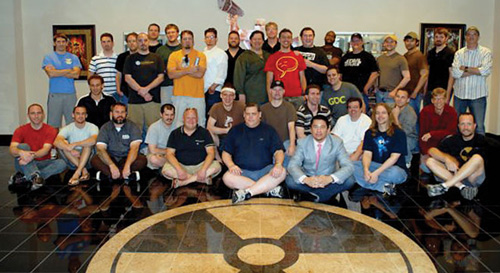
3D Realms. Not pictured: Duke Nukem Forever.
Before we answer, let me present you with another question: would you pay $10 for a $1 bill? No? Under the right conditions you might, and many of the folks at 3D Realms did basically that because of a psychological phenomenon called “escalation of commitment.”
Consider an auction 1 where a $1 bill is up for bid and the rules are (and this is the important part) that everyone who bids has to cough up their last bid whether they win or lose. Even when this is clearly explained to a room full of MBA students who should know better, someone always springs the trap by throwing out a bid of 1 penny in hopes of an easy $.99 profit.
Invariably someone else jumps on the bandwagon and outbids the first person, raising the stakes to two cents and a $.98 profit. But now the first person must either bid three cents or let the other person win and lose his initial 1 cent bid.
But people really hate losing money, so the second bidder is pretty likely to raise his bid to 4 cents, and the spiral keeps spinning until the break-even point of $1.00. Now one sheep-faced bidder has to decide whether or not to actually keep raising the bid and face a 1 cent loss even if he wins. Much of the time he will actually do it, presenting his opponent with basically the same conundrum.
Researchers running this experiment with groups of otherwise rational adults and had final prices go up to ten or even twenty dollars for a one dollar bill. 2 The reason is that bidders escalate their commitment to the auction by citing prior investments as justification for future ones, even though those costs are gone, immutable, and completely out of the picture. 3 Think of it this way: should you invest even one more cent on an auction that will only cause you to lose money even if you “win?” Or is it more rational to just cut your losses and bow out?
This is basically what many folks at 3D Realms did with Duke Nukem Forever. 4 According to that Wired article, the developers constantly threw money at the game, citing past expenses as the reason for continuing to invest money even when it was apparent that the game was doomed. And since they were self-funding the game, it wasn’t until the very end that they had a publisher standing over them and forcing them to end the cycle and either kill the game or polish it off for release.
This kind of thing happens in finance and business all the time. They probably wouldn’t have a name for it if it didn’t, though I kind of like the idea of calling it “Duke Nukem’s Disease.” But escalation of commitment doesn’t just happen with money. In fact, this quote from the Wired article suggests that this kind of dilemma was very much on the minds of 3D Realms employees and caused many of them to stick around longer than was good for their careers:
For longtime employees, the incessant delays posed two big problems. One was professional cred: Duke Nukem Forever was the only modern 3-D game some of them had worked on; if it didn’t ship soon, they’d have spent nearly a decade with nothing to show for it.
As a result of this, I imagine that a lot of them felt that the time they had invested up to that point was reason enough for them to persist, even if they felt their careers were taking a big hit. So it was back to escalating commitment and chewing bubblegum …until they ran out of gum.


Pingback: Explaining the Commitment to Duke Nukem — Forever [Weekend Reader] | zacsgames.com
Pingback: Explaining the Commitment to Duke Nukem — Forever [Weekend Reader] | DoozyDaily
Pingback: Explaining The Commitment To Duke Nukem — Forever | Kotaku Australia
I found this article incredibly interesting. The idea of escalating commitment is one that I was only partially aware of previously, but is something that I have been able to link to a whole bunch of things in my own life.
If I’m allowed to post links, I blogged about it here: http://shanewsmith.com/blog/2010/01/escalation-of-commitment/
Thanks! I love this site
Absolutely, thanks for the link!
What you fail to realize is that Duke Nukem Forever is not CANCELLED!! 3D Realms still claims it’s still under development with fewer developers.
So it’s not CANCELLED as you state in this article but I do not think we’ll ever see DNF in a finished state. 3D Realms has until end of 2010 before they must do another engine switch/restart with the DNF project.
Pingback: Explaining the Commitment to Duke Nukem — Forever [Weekend Reader] | Amazonys - Wii Games
Pingback: Window of Opportunity :TrentOster.com
Pingback: Escalation of Commitment | SELECT * FROM shane
What JE said directly ties into this. If you officially cancel a game you kill off any expectation of the prior commitments bearing any fruit, and can thus string people along (investors, devs, players) for an apparently infinite amount of time. As long as it isn’t cancelled there’s a chance that it’ll all be worth it!
This kind of delusion is not uncommon in the dev community, trust me.
I’ll believe it when I see a game on the shelf.
While escalating commitment is definitely a part of the equation, don’t forget Loss Aversion towards profit-sharing royalty agreements applied to anyone who left the company. “Golden handcuffs” as they like to call them. If you leave, you don’t earn your share, and since so few companies give out royalties the employees who actually appreciate or believe in that kind of thing tend to get double-screwed.
Escalating commitment, Loss aversion, and Sunk Cost Fallacy are a powerful Kool-Aid cocktail against rational behavior.
Yeah, I assumed there was a lot of different things at play there. I could probably do a whole article on golden handcuffs by itself.
This is exactly how auction/con-trick Swoopo.com works.
Pingback: EvilCast Recap, Episode #14 | Games Are Evil: 360, PS3, & Wii Console Gaming Magazine
Pingback: Beta ≠ Demo « PSC Gamer
this article is incomplete without the (awesome) chairleg story: http://hellforge.gameriot.com/blogs/Hellforge/Conspiracy-Theory-Duke-Nukem-Forever-and-a-Story-About-a-Chair
Excuse me. Does someone understand how to define true Expert Avisor from bad and a clear signals from fake? big thanks
Hello!
I support a mental disorder. Buy medicine online pharmacy. Please advise.
http://youcan.comsyhost.com/ – it’s a good drug store?