Seven Psychological Sins of SimCity Social

I have recently been hearing a lot about SimCity Social, the “Farmville with a candy coating of SimCity” game from Bigfish and EA. Mostly I’ve heard about how the game pulls all kinds of tricks to get players to spam each other, trade items, recruit new players, and spend real money. All of these things are par for the social game course, but apparently we have a more egregious than usual offender here. So I decided to investigate what psychological tricks SimCity Social pulls by forking over all kinds of pervasive permissions to my Facebook account and trying it out.

Wow. There’s so much going on here that within a few seconds I blacked out and woke up some time later in a puddle. I don’t know how this happened.

What I do know, though, is that SimCity Social wears many of its machinations on its custom tailored sleeve. I counted seven pretty much immediately and decided to stop there, because I love alliteration and had this great idea for a blog post title. The convenient thing is that these are all things I’ve written about before, so instead of going into depth on each I’ll give you the gist and then point you at other articles if you want more.

Sin #1: Reciprocity

Reciprocity is the impulse we feel to return favors, and it’s a pretty fundamental factor in human society and psychology in general.1 Whenever you get a free sample at the supermarket, the nice lady in the hairnet is banking on reciprocity to at least listen to her enthusiastic description of this new snack cracker if not buy a box right then and there. Famed psychologist Robert Cialdini explained in a 2001 article in Scientific American how the Disabled American Veterans organization used reciprocity to increase the success rate of their mail-based fundraisers from 18% to 35% simply by free return address stickers as a tiny gift with each appeal.

SimCity Social has gift trading baked into almost every aspect of the game. You can, once a day, gift other players with a few resources. If you’re low on specific resources –say a scientist to staff your research lab– you can request them as gifts. And you get points for every gift you accept. The game makes it easy for you to return the favor, and each exchange sends you a Facebook notification that prompts you to launch the game and keep playing. Non-players can receive gifts too, provided they first install the game and start playing themselves.

Read more about reciprocity:

Sin #2: Funny Money

Like most “wait to play” games, SimCity Social lets you spend real money to accelerate the game and get past the time and resource restrictions. Need more “bliss” to finish construction of your toy factory? I don’t know what “bliss” is, but you can get out your credit card and buy some! But, of course, you can’t just charge stuff straight to your card. You have to buy some of the game’s currency, little purple diamonds, and then spend those.

The problem is that like travelers spending money in a foreign currency, spending purple diamonds makes you susceptible to several biases and errors in thinking, ranging from being too lazy to do the mental currency conversions, to applying different (and irrational) mental accounting to diamonds than you would real money, to overspending unused diamonds because you don’t want to “waste” them.

Read more about funny money:

Sin #3: The Status Quo Effect

Let’s stick with the little purple diamonds for a minute. When you click to buy some, you’re presented with six different denominations you can buy, ranging from 900 diamonds for $100 to 35 diamonds for $5. Notice in the screenshot which of those options is selected by default, though: the most expensive one.

This is designed to take advantage what’s called the status quo effect, which describes our tendency to accept default settings, decisions, or options rather than make the often trivial effort to change them. This is especially true in ambiguous or cognitively demanding situations. For example, in one study,2 researchers were able to drastically increase the number of employees who participated in a savings plan just by requiring them to opt out of the program rather than opt in.

Similarly, more people shopping for diamonds should go with the default choice of 900 for $100. Of course, many of you may be thinking that this is too extreme to work in most cases; most people are looking to spend just a few bucks, not $100. And you’re probably right, but SimCity Social uses the status quo effect elsewhere as well. Whenever you have to confirm sending a request to another player via Facebook, the system automatically checks a box that says “Don’t ask again before sending requests to [NAME] from this app.” When you accomplish something in the game, it often throws up a notification that includes the ability to “Share Rewards” to your Facebook wall after you click “OK.” This is, of course, selected by default as shown in the screenshot above.

Read more about the status quo effect:

Sin #4: Artificial Scarcity

Sometimes we just want something because we soon won’t be able to have it. This is known as the scarcity effect. Consider a simple 1975 experiment by psychologist Stephen Worchel3 where researchers offered subjects a chocolate chip cookie from one of two jars. One of the jars had many cookies in it. The other had only a few. In reality, they were THE SAME COOKIES but people reported the cookies from the mostly empty jars as more delicious, more desirable, and more expensive. Just because they were more scarce, and our brains are wired to be averse to losing the option to have something once it’s available.

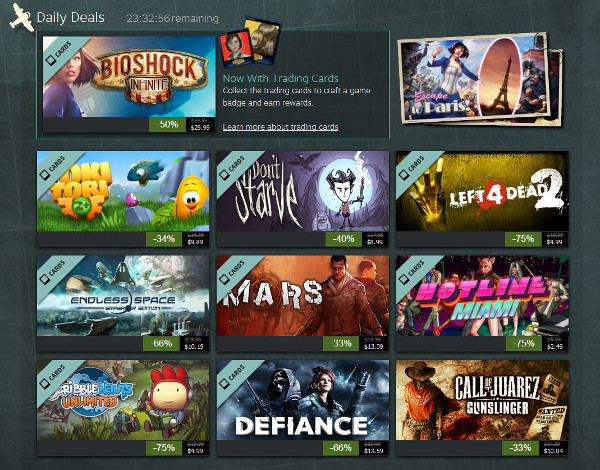
We see the same thing with plentiful goods or digital goods with limited time offer. If something is on sale for one day only, we’re averse to losing our chance at getting it for a good price and are more likely to buy it than we would if it were that same low price every day. Just look at Steam sales or Amazon.com’s deal of the day. SimCity Social creates this artificial scarcity by offering you a deeply discounted new building every time you level up. But you have to buy it RIGHT THEN before dismissing the “Level up!” notification –the text stresses “One Time Offer! You will NEVER see this offer again!”

Read more about scarcity:

Sin #5: Endowed Progress

Once we get started down the road to a goal, we’re reluctant to give it up. This is a great hack you can use to motivate yourself to reach goals, but it can also be used against you. And what’s more, it turns out that we’re super susceptible to suggestions that we have already started an undertaking, even right off the bat.

My favorite example of what’s called the endowed progress effect is a 2006 study by Xavier Dreze and Joseph Nunes4 where they gave half the customers at a car wash a rapid rewards card that required 8 total stamps to get a free wash. Others were given a similar card that required 10 total stamps, but were given two freebie stamps to get them started. So both groups needed only 8 more stamps, but the one that got kick started with the two freebies were more likely to come back for future visits and to wait less time between them.

SimCity Social leverages the endowed progress effect in a few ways. Upgrading building requires various resources, but you’ll often have at least some of these before you start and will thus immediately see something like “2 of 20 hard hats” when you check the progress of your upgrade. Each game chapter also has multiple, specific goals for completion (e.g., “Build a Bakery”) and I found that I had often already satisfied one of those goals in the course of messing around on my own.

Read more about the endowed progress effect:

Sin #6: The Availability Heuristic

The availability heuristic kicks in when we overestimate the frequency of event because instances of that event are easy to recall from memory –they are, in other words, more available for recall. (Interestingly, the converse is true as well; if we have difficulty remembering examples of something, we underestimate its frequency.)

Many things can make an event easier to recall from memory, including seeing it happen to friends. SimCity Social capitalilzes on this by encouraging you to spam the living daylights out of your wall with notifications of things that you’ve done in the game and the fact that you’re playing the game in the first place. Friends who see these notifications recall them more easily and are thus likely to overestimate the popularity of the game when they see an ad or receive an invitation to play.

Read more about the availability heuristic:

Sin #7: Benign and Malicious Envy

Social comparisons are, unsurprisingly, important to social games. This includes that old standby, envy, especially what’s been called “benign envy.” As opposed to “malicious envy” where you want to tear down the other person and take away their pretty shiny thing, benign envy is elicited when we think that a person deserves what they have because they earned it. Benign envy motivates us to improve ourselves (or pay money) to get the same rewards. In one study5 researchers instilled benign envy in a group of college students by having their friends earn a new iPhone. As a result, subjects said they were willing to pay 64% more to get their own iPhone.

SimCity Social capitalizes on benign envy when you visit other players’ towns. You can see everything they have built and bought. What’s interesting (and probably the most amusing thing about the game) is that you have the option to be either kind or mean to them as you click on all their stuff. You can “knock over display stands” in their stores, or you can “compliment the decor” when you visit their Mayor’s home. You can even send either hot air balloons across their skies, or a flock of incontinent seagulls. And, of course, if you experience benign envy over their accomplishments and layout, you may be more motivated to recruit more friends or buy some of those purple diamonds to keep up with them.

Read more about the benign envy:

So, there you go: my epic post on the psychological shenanigans of SimCity Social. I’m not saying Playfish set out to brainwash you –these are old design principles and the people who make videogames tend to be smart so they figure out and remember what works. Nor are they unique to SimCity Social, in that most of them apply in one way or another for most social games in this vein. But if you decide to engage in a little urban development on Facebook, everything above is good to keep in mind.

P.S., Thanks to readers Zachary and Danielle for stepping up and accepting the friends request to play the game with me and pose for some screenshots.

Three Reasons Why We Buy Those Crazy Steam Bundles

Steam, the digital game distribution platform owned by Valve, often has these weird bundles for sale where they cram together, for example, every id Software or every Rockstar game or every game featuring squirrels into one package. One message board I frequent has a mega thread dedicated to gaming bargains, and doing a search for “Damn you, Steam” produces results like these:

“Damn… maybe I want Colonization. Have CIV IV & BTS on Disc. Should I just get Colonization @ $10.19 or just get them all and have on Steam for a wee bit more. Damn you Steam.”

“Damn you Steam! More games to buy that I’ll probably never get to play.”

“Damn you Steam. I had just successfully resisted the urge to buy games at both the holiday sale from GoGamer (Heroes of M&M 5 Complete and EU:Rome at $10 each were tempting, and Company of Heores Opposing Front for $5 is a steal) and the last round of Steam Deals (King Arthur especially was calling my name), and now you put Civ IV complete (I own none of the Civ IV stuff) out there for $14. My game backlog can’t take much more of this!!”

“This is madness. I am buying games for a theoretical PC that I will build someday (maybe) so I can play them. Damn you, Steam.”

“Got $170 sitting my cart. Staring at it trying to figure out how to cut it down some. Damn you, Steam.”

People are talking like Steam is forcing them to pounce on such deals when they happen even though they already have a huge backlog and may actually already own physical versions of half the games included.

What makes these plainly ridiculous bundles so attractive? I’m glad you asked, because I can think of at least three psychological principles at play here.

Scarcity

First, In marketing there’s a well worn principal called “the scarcity effect.” When something is scarce, it automatically becomes more desirable to us than it would be if it were available everywhere we looked. This “available in limited number” trick shows up everywhere from collectable trading cards to special “limited” editions of new game releases.1 Ever noticed a store front that had a “going out of business!” sign in the window for months on end? That’s the owners trying to capitalize on the scarcity effect. Buy now, sucker, or it’ll be gone!

Consider a simple 1975 experiment by psychologist Stephen Worchel to provide an illustration of this concept involving baked goods.2 Posing as a consumer products survey, the experimenters offered subjects a chocolate chip cookie from one of two jars. One of the jars had many cookies in it. The other had only a few. Of course, people reported the cookies from the mostly empty jars as more delicious, more desirable, and more expensive. This despite that the cookies in both jars WERE THE SAME COOKIES.

But Steam and similar download services like Direct to Drive sells digital games, right? They’re not cookies that are about to disappear, there is literally an UNLIMITED SUPPLY of the 1s and 0s that comprise these digitally distributed games. True, but the scarcity effect still applies, because it’s not so much the scarcity of the physical product that we react to, but the opportunity to buy it. Often these bundles are put up a limited time sales and people HATE losing opportunities to do things once they think they’re within reach.

Notice the WEEKEND ONLY! verbiage. Act now or you'll lose!

Obscuring True Value

The second psychological principle at play here is the fact that it’s hard for shoppers to look at a bundle like that and understand what its true value is. William Poundstone, author of Priceless: The Myth of Fair Value (And How to Take Advantage of It) calls this the “value meal” strategy when describing the psychology of restaurant menu design. How much cheaper is it to get the bundle? What about if I super size it? With curly fries? Oh forget it, just give me the #3.

Likewise, we look at a massive bundle of digitally distributed games and think about how much could I get those older games for elsewhere? Could I find them for sale used, and for how much? Could I rent or borrow any of them? For the games I already own, how much is it worth to me to have them available through Steam so that I don’t have to dig out my old boxes and CD keys? It’s a psychological truism that we have limited cognitive processing power at any one time, and when our brains are tied up considering these questions, we’ve got fewer cycles to devote to thinking about other stuff, like how much we want to actually PLAY the games and to avoid other irrational pitfalls.

Not that this keeps the folks who run Steam from telling us exactly how much the bundle is worth, though, which brings me to the third psychological factor in play: anchoring.

Anchoring

In the context of the psychology of prices, anchoring refers to presenting shoppers with a number in order to get them to “anchor” their perceptions of value on either a high or low absolute. The “low ball” offer is the classic example –open a negotiation over price with a really low number and you’ll set the stage so that what you’re actually willing to pay looks higher in comparison.

As a simple but elegant example, consider an experiment done by psychological wizards Amos Tversky and Daniel Kahneman.3 The researchers asked one group of subjects to estimate the product of these numbers:

8x7x6x5x4x3x2x1

And then they asked another group to estimate this product:

1x2x3x4x5x6x7x8.

Those of you with a grade school education may know that because of how multiplication works these products are equal.4 Yet the average estimate for the group that was given the problem starting with “8″ was 2,250 while those who saw a “1″ at the beginning of the problem had an average estimate of just 512. Why? Because one group anchored on a high number and the other anchored on a low number.

Similarly, behavioral economist Dan Ariely and his collegues conducted a study5 where he used anchoring in an auction simply by having bidders write down the last two digits of their social security number at the top of their bid sheets. Those whose numbers ended in the 80s and above actually were willing to pay up to 346% more for things like wine and chocolates than were those whose social security numbers ended in the 20s or below. CRAZY.

Not one, but two anchors here

How does this relate to those Steam bundles? Well, look closely at one of those promotions and you’ll see that the marketing gurus for the service readily list the retail value of the bundle if you paid full price for all games individually. That’s your anchor; seeing that number will cause many people to set their perceptions of the bundle’s value much higher than if they had seen the sale price alone. In addition, the difference between the “unbundled” and sale prices can trigger the contrast effect, which could be considered a fourth psychological principle at play.

So there you have it: you’re broke and have way too many games to play because you don’t want to lose opportunities to buy something, you’re befuddled by pricing, and your perceptions are anchored by arbitrary “normally sells for…” prices. Now, if you’ll excuse me, I have to go play Commander Keen, Doom, Final Doom, Doom II, Doom 3, Hexen, Hexen II, Heretic, Quake, Quake II, Quake III Arena, Wolfenstein 3D, Spear of Destiny, Return to Castle Wolfenstein, and more mission packs than I care to think about.