Articles for Edge Magazine Online

Last year I wrote several articles for Edge Magazine about the psychology of various video game topics. Somehow I missed that Edge put these online for viewing, so in case you didn’t catch the print editions I’ve helpfully aggregated them all here in one post. Wait …hang on, I’ve got to check something. Okay, yes. “Aggregated” is the right word here. Sorry.

Simply click with as much authority as you like on any of the images below to read the full article.

The Psychology of High Scores

The Psychology of High Scores

The Psychology of Nostalgia

The Psychology of Nostalgia

The Psychology of Genres

The Psychology of Genres

The Psychology of Avatars

The Psychology of Avatars

The Psychology of Free to Play Games

The Psychology of Free to Play Games

Enjoy!

The Psychology of Game Nostalgia in Edge Magazine #242

Another of my articles on the psychology of video games has been published in Edge Magazine, Issue #232 July 2012. This time I wrote about the nostalgia we feel for good old games and how game developers and marketers capitalize on nostalgia to sell us reboots, sequels, and retro games. I have written about nostalgia before, but as is typical with the Edge articles I did a lot more research this time and investigated some additional ground.

For example, a lot of what I learned about nostalgia pointed towards how when we feel the emotion it makes us think about interpersonal relationships. I sent Bobo The Quote Monkey on his monthly fetch quest, and here’s what he got:

Nostalgia and social connections go hand in hand, then. Thinking about the loss of social connections, as nostalgia often makes us do, primes us to think about repairing those connections, maintaining current ones, or establishing replacements. Wildschut and his colleagues also found that when asked to describe nostalgic memories, most people recalled social contexts and good relationships with others. And research on the power of music has found that song lyrics emphasizing social relationships, including friendship, love, and familial bonds, were the most likely to induce nostalgia in subjects.

…You may reminisce about playing the original StarCraft, but the chances are you’re most nostalgic thinking about throwing down with friends in multiplayer or at least bonding with them over the shared experience of discussing how you managed the campaign. For gamers, our most nostalgic memories probably revolve around sharing the hobby with others, making new friends, and enjoying a good couch co-op experience.

That idea flows into something interesting that occurred to me about the nostalgia that today’s new gamers will feel years from now:

If nostalgia is tied so closely to social connections and a sense of community, games have the potential to evoke it more than any other medium, because they are so inherently social and are becoming more so every year. Early games might have been shared experiences on the couch or via playground discussions in much the same way as movies or TV, but the majority of new games coming out this year will feature mechanics or tools that encourage players to share, compete, communicate, help, and socialise. The same can’t be said of music, movies, TV, or other common vessels of nostalgia. It seems that games might someday boost more moods than anything else in history.

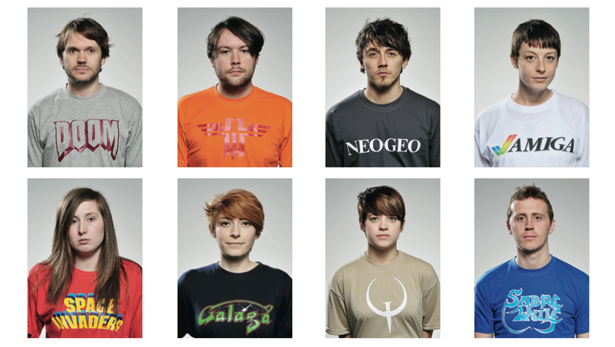
So, if any of that sounds interesting to you, check out the issue on either the news stand or via the digital edition. I’ll also note that I particularly loved the graphics accompanying this article. They took portraits of a bunch of people wearing tee shirts featuring logos from old gaming properties. There’s everything there from Crazy Taxi to Doom to Space Invaders. Just looking over those pictures made me nostalgic.

Why We Get Nostalgic About Good Old Games

Imagine for a moment that you’re a Swiss mercenary away from your homeland and fighting for some European king during the 17th century. Now suppose that over cups of hot coco and hair braiding you and your fellow mercs begin to pine for the good old days when video games came with thick manuals and forced you to micromanage your system memory in order to get things to run. Most likely you would all be referred for treatment of a neurological disease, not only because video games didn’t exist in the 17th century, but also because nostalgia in any form was considered a malady of the mind on par with any other physical disease. Proto-psychologists of the time thought that the condition was limited to the Swiss people, and attributed it to all kinds of weird stuff, including pressure from tiny demons squeezing the wrong parts of your brain, changes in air pressure forcing blood up into the skull, and brain damage resulting from the prolonged clamor of cowbells.1

Current research has progressed quite a bit, and generally defines nostalgia along the lines of an emotional state characterized by sentimental longing for things in one’s past. It’s a common concept, and it’s not unusual to encounter some old fart of a gamer reminiscing about how much better and more fun things used to be back in the old days. If you ever find yourself in a room full of gamers and want to cull out these people, just say the following words in a loud, clear voice: “Man, how about that Nintendo Entertainment System?” Then just tag all the people who won’t stop talking. Double tag the people who use words like “DOSBox” or “gog.com.”

This begs the question, though, of why we feel nostalgic about games2 at all. And more curiously, why do we so often look at the past through rose-colored glasses and claim that old games were so great? This despite the honest fact that today we’d rather chew our own faces off than use pencil and graph paper to find our way around a dungeon or type IP addresses into a command line to find a multiplayer match –with vanilla deathmatch as the only option, no less. Yes, some games are classics and serve as important signposts on the medium’s road to maturation, but seriously even today’s mediocre games and hardware represent improvements on every front. So why do we get all nostalgic?

The N64 is the greatest gaming console ever! Because I was delighted to get it for Christmas one year!

(Photo credit: Hendricks Photos.)

To answer that question it might be useful to look at what psychologists think are the triggers and reasons for nostalgia in general. A few years back several researchers from the University of Southhampton published an article in Journal of Personality and Social Psychology that revealed a few things about the content, triggers, and functions of nostalgia.3

For example, the researchers found that our nostalgic narratives most often featured a “redemption sequence” where the subject started off down in the dumps, but found a way to parlay that experience into something positive. So maybe your love of games made you a bit of a social outcast in general, but you formed one really solid friendship with a kindred soul. Or maybe you learned something about lawn care and the gray market for kidneys4 in the course of saving up for a Sega Genesis.

The link between negative moods and nostalgia also came up when the researchers looked at what triggers bouts of the emotion. They found that feeling down in the dumps or displeasure over current circumstances is likely to prompt people to reminisce about some uplifting experience in the past. So maybe you’re more likely to get nostalgic for the 8-bit era when some high def, high poly foes are sucking all the fun out of your current experience.

These findings all point to the idea that we engage in nostalgia because it has psychological benefits. It makes us happy and improves our state of mind, especially when we need that kind of mental pick-me-up. Specifically, nostalgic reverie about a time when we were enjoying ourselves or finding ourselves particularly competent or connected to other people raises feelings of self-regard, which is a feeling that well-adjusted people tend to like. Today’s role-playing games are all about grinding that I don’t have time for, remember when I got my entire party of characters in Final Fantasy IV to level 99? Man, I was hardcore then.

Name? Job? Lack of dialog tree?

But is what we’re remembering accurate or really representative of what we felt at the time? The fact that we seem to engage in nostalgia specifically to make us feel better suggests that we may be unconsciously biased towards remembering things that make us happy and against remembering the things that don’t. We have a remarkable propensity towards that kind of thing. It’s cute, really. We require less information to confirm beliefs when they are consistent with our current state of mind5 and a substantial body of research6 has shown that we are predisposed to remember more of the good things in life. For example, one pair of researchers7 asked subjects floating in a sensory deprivation tank to recall and rate experiences from their past. Sixty-six percent of the recollections were considered positive (or “of positive affective valance”, as it’s said in the biz) while the remainder were neutral or unpleasant.8

An additional wrinkle in memory’s landscape is that the emotional footprints of positive memories tend to fade more slowly than those of negative ones.9 This is something known as the “fading affect bias” though I prefer “fading affect effect” because it’s punchier. Regardless of what you call it, this might be due to the fact that downplaying negative memories is an effective coping mechanism and leads to better mental health –a far cry from having tiny, nostalgia-inducing Swiss demons swimming around in your brain.

Or it could all be a case of bad mental aim. Another group of researchers claim that vividly remembered events seem so great relative to the hum-drum of the present because simply remembering something feels good. Jason Leboe and Tamara Ansons reported on studies10 showing that people tend to have an “Ah-ha!” moment when experiencing easy recall of information, and that kind of moment is innately pleasurable. It’s just a cognitive quirk in the brain. What we tend to do, the researchers argued, is mistakenly attribute the pleasure not to the easy recall of the experience, but to the experience itself. While some stand-out experiences obviously were pleasurable, this kink in the human brain biases us towards erroneously remembering such events as more positive than they were.

So, next time you’re feeling nostalgic about how great Quakeworld or the original Donkey Kong Country was, I recommend going with it. It’ll make you feel better even if you overlook the problems at the time or the improvements that have been made since. Just don’t over commit yourself to any opinions born of memory’s fickle biases. Because graph paper, himem.sys, and two buttons on a controller were worse than you really remember.

Did you find this kind of thing interesting? Well, if you say so. You might want to follow me on Twitter, RSS, or Facebook to see more.