Last Thursday I did a talk at 2010 Login Conference in super nifty downtown Seattle. The title of the talk was “The Psychology of Games: Why We Do What We Do When Playing With Friends (And Screw That Other Guy).” I was pretty proud of myself for getting a talk accepted when it included a mild vulgarity in the title and had promised to make the slides and my notes available on the site after the conference. BEHOLD:
Perform clicking motions above to download a .pdf version of the presentation, including my stupid little personal notes.
Anyone who is a regular reader of this site may be a little disappointed, though, because it may appear that most of the talk was based on articles I’ve already posted here. Not true! It’s actually the case that the articles posted here were based on the lecture. I had to submit a detailed outline with my proposal several months ago, and after it was accepted I decided to create blog posts out of the stuff I was pulling together for the talk. In academia, we call this technical process “squeezing blood out of a stone.” Or a turnip. Your choice.
Anyway, I think the talk went fairly well, and I was pleased to see a handful of regular readers/commenters there. 1 One of them (“Psychochild” I think) even did some impromptu group participation by shouting out “Line B!” in the part of the lecture illustrating the social proof concept. When I get up in front of a crowd I actually don’t see it when I look at it, but I was told later that the room was mostly full and people were taking notes. Because the computer that I was using chewed up some of my notes formatting I got a little lost and missed making a few points, but I think I got the main points and came in just about 30 seconds under the 60 minute time limit. Look, here’s even a picture of me gesturing in a semi-academic way:
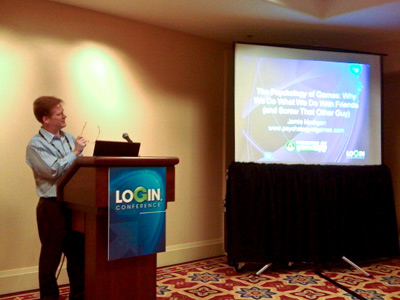
"Rest assured, ladies and gentlemen, that the quality of this presentation is such that several of the slides within contain extreme vulgarities."
And so, with that I’m going to shut up about this whole Login talk thing for a while. All the talks were video taped, however, so I’ll break that silence once the conference folks post them online for you to view. Not just for mine, but also because there were several other really good talks with psychological angles on things like addiction, motivation, and mental accounting that I think anyone visiting this site 2 would be interested in. So I’ll highlight those once they’re available.


It was, indeed, me that helped demonstrate the concept. 😉 Great talk even if it was mostly a retread.
Nice meeting you, as well. 🙂
Jamie, I recommend you use something like SlideShare.com or Scribd, so you can embed the entire slides set into this blog post.
Some interesting ideas in there, thanks. I never really thought I’d be able to apply the psychology I learned in university. Now I just have to use it for good, and not evil.
Page 25: “provide queues to give people things in common” — Do you mean “cues”?
Pingback: Lessons Of The Mario Kart Cheaters | Kotaku Australia
Saw this linked from Kotaku who were talking about the Mario Kart slide.
I have one question what happens if you correct for the number of people who have 0, 1, 2, 3, etc. friends?
The Wii is a uniquely difficult console to connect to other people, so I would expect there to be more people with lower numbers of friends – to be honest the graph looks exactly how I expect the graph of numbers of friends Wii users have, with the vast majority having only connected it to the Internet and not actually added anybody at all.
Is there a graph which show % users who cheat vs. number of friends? That would remove the bias due to the different numbers of people who have 0, 1, 2, etc. friends.
Or is their data from other consoles which back up this trend?
Pingback: Meet GameSpy Technology at Login 2011 | GameSpy Technology